Researched buying guide. We have not tested the products or mount types described here. Last reviewed: 15 November 2026.
A phone on your handlebars is the easiest way to get navigation, but it is also the accessory most likely to be bought wrongly. The short answer: choose a mount made for motorcycles, check that it fits your handlebar or mounting point, and think hard about vibration before you attach an expensive phone to a bike with a powerful engine.
Who this guide is for
- Riders who want a phone for navigation or ride tracking on a commuter, scooter, adventure or touring bike.
- Riders unsure whether their phone camera could be harmed by engine vibration.
- Anyone comparing mount types before they spend money.
Start with vibration, because it can damage the phone
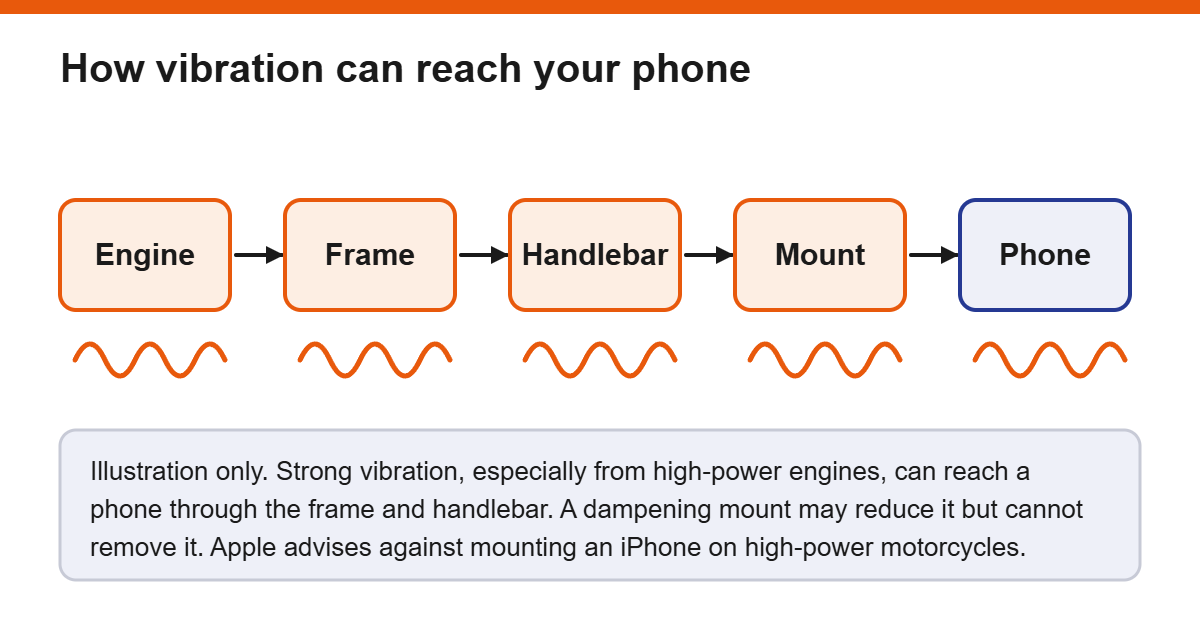
Apple has published a support note warning that long-term exposure to strong vibration, especially from high-power or high-volume motorcycle engines, can degrade a phone camera’s optical image stabilisation (OIS) and closed-loop autofocus, which reduces photo and video quality. Apple advises against mounting an iPhone on motorcycles with such engines. For lower-vibration vehicles such as mopeds and scooters, it recommends a vibration-dampening mount and avoiding regular use for long periods. See Apple’s own page for the current wording and the models it covers (we link to it in the sources below).
What this means in practice:
- The warning is from Apple and is about iPhones. We have not found an equivalent official statement for other phone brands, but any phone with a stabilised camera could in principle be affected, so it is sensible to treat it as a general risk.
- A dampener may reduce vibration but cannot remove it. Treat it as risk reduction, not a guarantee.
- If camera quality matters to you, consider a cheaper dedicated device for navigation, or take the phone off the bike when you are not navigating.
The main mount types
| Type | Where it attaches | Points to check |
|---|---|---|
| Handlebar clamp mount | Round handlebar | Bar diameter, spacers supplied, tightness over time |
| Mirror-stem or lever-perch mount | Mirror stem or the bolts at the brake or clutch lever mount | Bike-specific fit, hardware compatibility |
| Stem or bracket mount | Dash, stem or a bracket fitted for the purpose | Whether your bike has a suitable point, extra parts |
| Spring-clamp holder | Grips the phone’s sides | Phone size and thickness limits, case compatibility |
| Case-based or twist-lock holder | Locks onto a matching case or adapter | Needs a compatible case or adapter, which may cost extra |
| Magnetic holder | Magnet holds the phone | Apple has separately warned that magnetic accessories near the rear camera can interfere with its stabilisation, and magnetic grip may not suit rough roads |
Which options exist depends on your bike. Check your own bike before you choose.

Check the fit before anything else
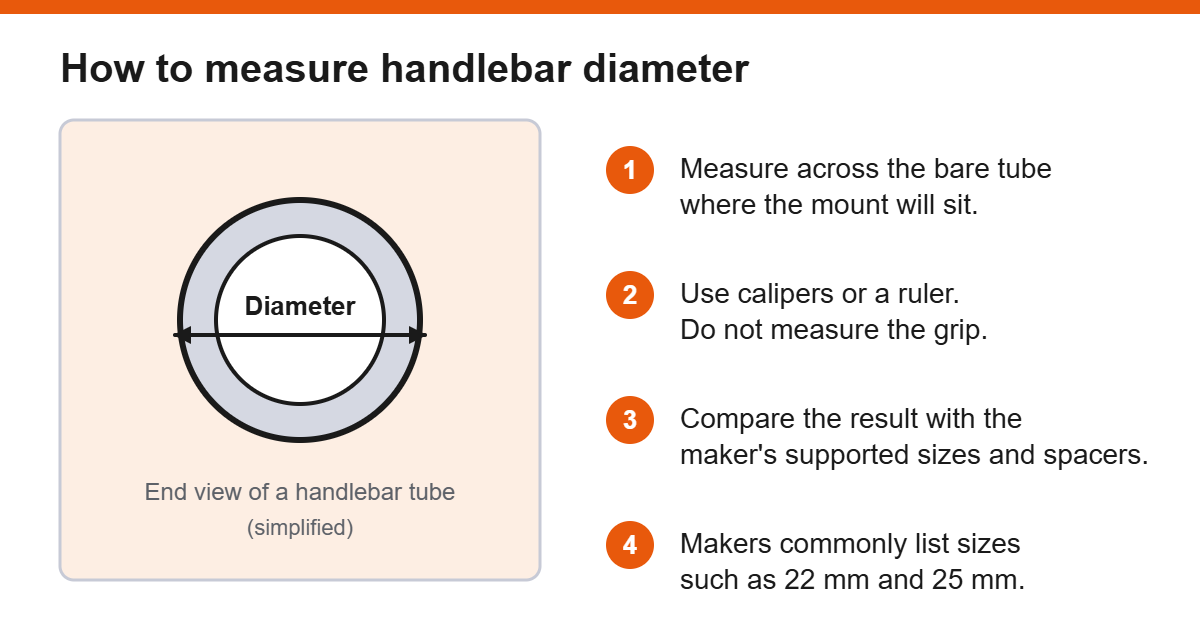
Handlebar diameter
Measure your handlebar with a ruler or calipers rather than guessing. Mount makers commonly list support for sizes such as 22 mm and 25 mm, and many supply rubber spacers or adapters so one mount can fit several bar sizes. Always check the exact model’s list of supported sizes and what spacers come in the box.
Phone size, thickness and case
Some holders only accept phones up to a certain thickness, and many case-based systems need a particular case or adapter. A thick protective case can stop a phone fitting a spring holder.
Total cost
Add up everything you will need: the mount, any case or adapter, a vibration dampener if it is sold separately, and a waterproof cover if you ride in the rain. A cheap mount that needs three add-ons may not be cheap.
Phone use and mounts in India
Section 184 of the Motor Vehicles Act, 1988 (driving dangerously) includes an explanation that lists “use of handheld communications devices while driving” among the acts that amount to driving dangerously. The section applies to any motor vehicle, which includes motorcycles. As reproduced on a legal reference site, a first offence carries imprisonment of at least six months and up to one year, or a fine of one thousand to five thousand rupees, or both, with heavier penalties for a repeat offence within three years. Penalties and enforcement can change, so check the official text on the India Code portal.
- A mount does not make the screen safe to use. It only keeps the phone off your hand. Set your destination before you move, use voice directions or a helmet communication system, and stop in a safe place to change anything.
- Mounted navigation. We could not find official text that says whether using a mounted phone for navigation on a motorcycle is allowed. Do not assume a mount makes phone use legal, and follow your state traffic police’s guidance.
- Heat and rain. Strong sun and heavy rain are hard on phones. Check your phone maker’s guidance on heat and water resistance, and consider a waterproof cover for monsoon riding.
- Handlebar sizes. They differ between bike models, so measure your own bike rather than relying on a model name.
Mistakes to avoid
- Using a car mount on a motorcycle. Car mounts are built for different conditions, and retail guides generally advise against using them on bikes.
- Ignoring vibration. See the section above.
- Not checking the clamp. Re-check tightness regularly, and replace a mount with cracks or loose parts.
- Blocking controls or your view. Position the phone so it does not interfere with the controls, instruments or steering at full lock.
- Using the phone while riding. Handheld phone use while driving falls under Section 184 of the Motor Vehicles Act. Set up navigation before you ride and do not touch the screen while moving.
Who should skip a phone mount
- Riders of high-power, high-vibration bikes who care about their phone’s camera.
- Riders whose bike has no safe place to fit a mount without interfering with the controls.
- Anyone who would be tempted to read the screen constantly. A voice-guided setup or a dedicated navigation device may suit better.
A quick checklist before you buy
- Measure your handlebar diameter (or confirm the mounting point).
- Note your phone’s size, thickness and whether it has a case.
- Decide how you will handle vibration (dampener, device choice, or removing the phone when not navigating).
- Check what comes in the box, and list any extras you will need.
- Check the maker’s guidance for your bike type and any local rules.
Frequently asked questions
Will a phone mount damage my phone?
The risk is mainly to the camera’s stabilisation and autofocus systems from long-term exposure to strong vibration, according to Apple’s guidance for iPhones. It depends on the bike and how often and how long you ride with the phone attached.
Do I need a vibration dampener?
For lower-vibration vehicles, Apple recommends a dampening mount. A dampener can help but does not remove the risk, particularly on powerful engines.
Can I use my bicycle or car mount on a motorcycle?
We would not. Use a mount designed and rated for motorcycles, and check its stated fit and limits.
Conclusion
Choose the mount around your bike and your phone, not the other way round. Measure first, plan for vibration, count the extras, and set up navigation before you ride. When we add specific product recommendations to this guide, they will be clearly labelled and explained.
Related guides
- Browse more in Motorcycle Electronics.
Sources
- Apple Support: Exposure to vibrations, like those generated by high-powered motorcycle engines, might impact iPhone cameras (published November 2023; check the page for current guidance).
- Apple Support: Magnetic accessories might interfere with iPhone cameras.
- Quad Lock: Handlebar mounts (example of a maker’s handlebar size and spacer information).
- ROKFORM: Handlebar mount FAQ (example of a maker’s handlebar size and spacer information).
- Motor Vehicles Act, 1988, Section 184 (driving dangerously, with the explanation on handheld communications devices): text as reproduced by Courtbook. This is a reference site, so check the official text on the India Code portal.