Researched buying guide. We have not tested the products or product types described here. Last reviewed: 15 November 2026.
A USB charger on your bike keeps your phone alive for navigation, but it is also an electrical add-on to a machine that vibrates, gets wet and has a limited battery. The short answer: choose a weather-sealed unit, fit it with its own fuse, wire it so it only draws power when the ignition is on, and have a workshop do the wiring if you are not confident.
Who this guide is for
- Riders who use a phone for navigation and want it charged on longer rides.
- Riders choosing between a USB socket, a cigarette-lighter style socket and a power bank.
- Anyone unsure how to power an accessory without draining the battery.
The main options
| Option | Good for | Watch out for |
|---|---|---|
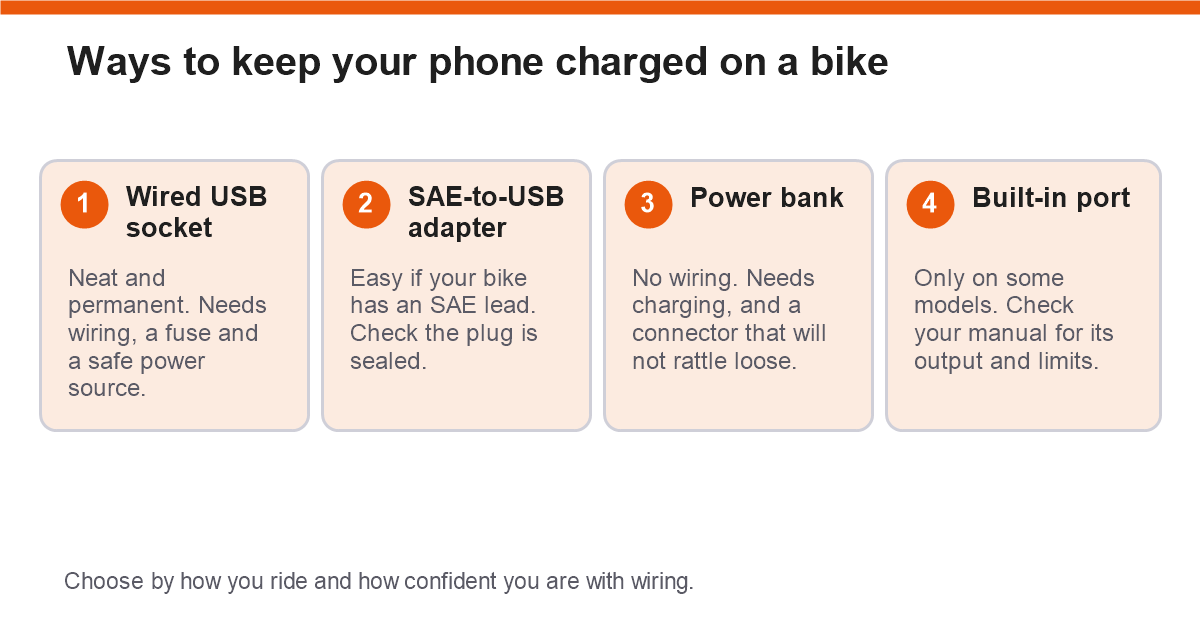
| USB socket wired to the bike | A neat, permanent setup | Needs wiring, a fuse and a safe power source |
| SAE-to-USB adapter | Easy to fit if the bike has an SAE lead for accessories | Check the plug is weather-sealed and the lead is routed safely |
| Power bank in a pocket or bag | No wiring at all | Needs charging, and cable and connector reliability matter |
| Built-in USB port from the maker | Designed for the bike | Only on some models. Check your manual for the output and limits. |
Weather protection: read the IP rating
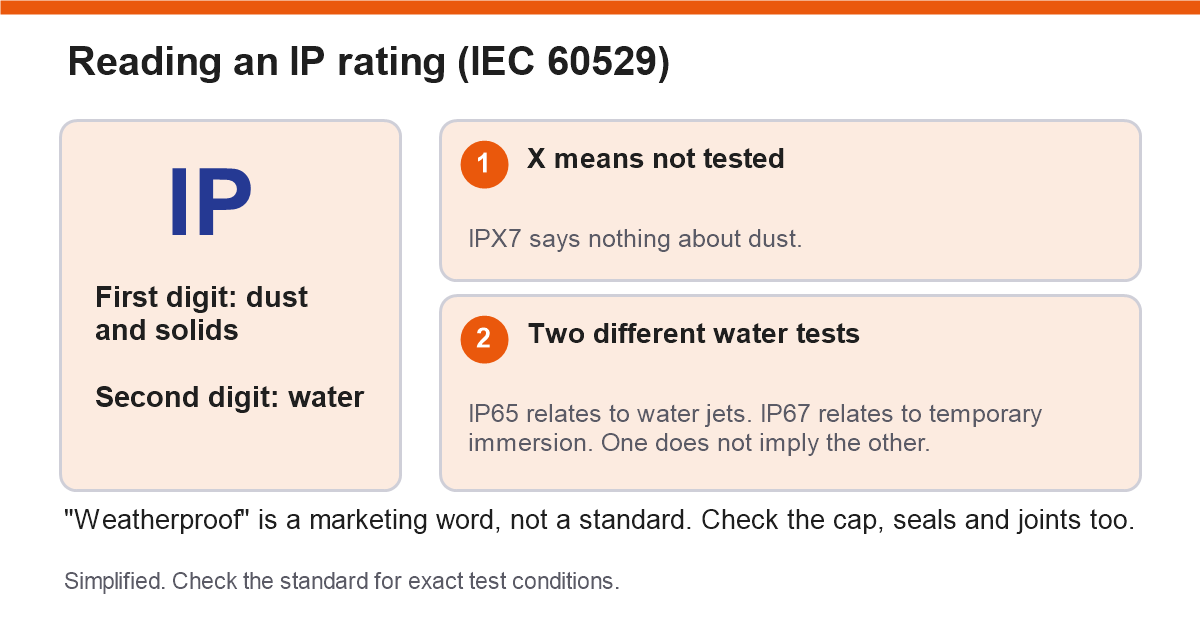
IP ratings come from the standard IEC 60529. The first digit covers dust and the second covers water. An “X” means that digit was not tested, so IPX7 says nothing about dust. IP65 relates to jets of water, while IP67 relates to temporary immersion, and the two are different tests, so a rating of IP67 does not by itself mean a unit passed the jet test. “Weatherproof” is a marketing word, not a standard.
- Choose a socket or adapter with a stated rating and a cap or seal that closes properly.
- Think about monsoon rain, road spray and washing the bike. A rating is only as good as the cap, the seals and the joints in the wiring.
- Ratings do not cover sunlight, which can age plastic over time.
Power: how much does your phone need?
Typical USB outputs are in the range of a couple of amps, enough for a phone running navigation. Check the output rating on the unit and your phone’s needs. A bike’s electrical system has a limited reserve, so avoid adding many accessories without checking the bike’s manual and, if needed, a workshop.
Wiring: the part that matters most
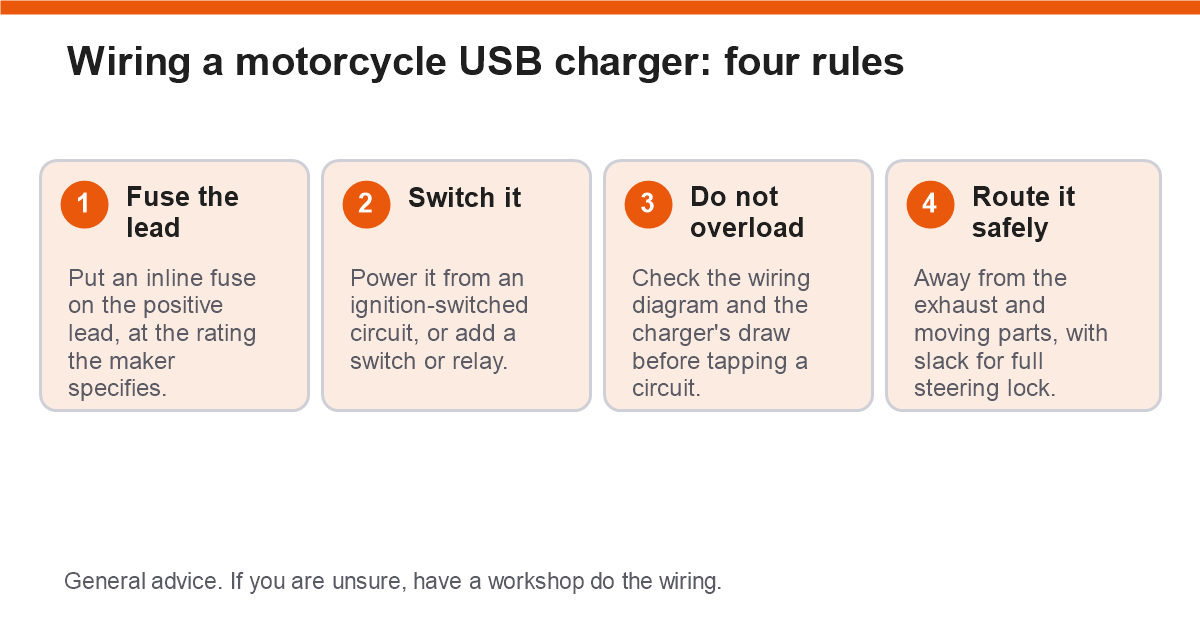
- Use a fuse. Guides we read say the positive lead should always have an inline fuse, and kits typically include one. Use the fuse rating the maker specifies.
- Do not drain the battery. A charger connected straight to the battery can draw a small current even with nothing plugged in. One rider reported measuring about 14 milliamps and a flat battery after a few weeks of sitting. Makers quote different standby figures, so check the unit’s own figure.
- Switch it. Common fixes are to power the charger from an ignition-switched circuit, so it only works with the key on, or to add a switch or relay.
- Do not overload an existing circuit. Tapping a lighting circuit may work for a low-draw item, but asking too much of it can blow a fuse. We found no standard figure for a safe limit, so check your bike’s wiring diagram and the charger’s rated draw.
- Route the lead safely. Keep it away from the exhaust, moving parts and sharp edges, leave slack for the steering to turn fully, and secure it with ties.
- Let a workshop do it if unsure. Wiring mistakes can cause faults or fires, and may affect your warranty.
Modifications and warranty
Check your owner’s manual and ask your dealer before adding wiring, especially while the bike is under warranty. A neat plug-in accessory lead is usually less of a concern than cutting into the loom, but ask first. Section 52 of the Motor Vehicles Act restricts altering a vehicle so its registered details no longer match. We could not confirm whether a USB socket counts as an alteration, so ask your local RTO if you are unsure.
Charging a phone on a bike: other things to know
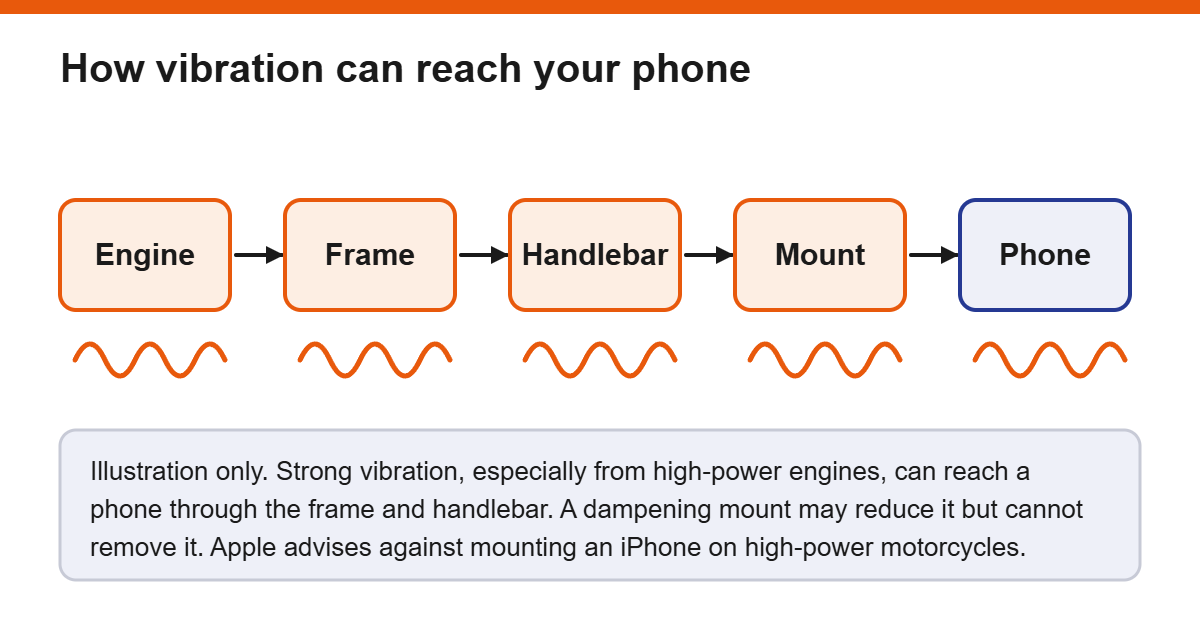
- Vibration. Engine vibration can harm a phone’s camera stabilisation. See our motorcycle phone mounts guide.
- Heat. A phone in direct sun, charging and running navigation can get very hot. Keep it shaded where you can.
- Cable and connector. A short, secure cable with a firm connector is less likely to rattle loose than a long one.
- Phone use while riding. Section 184 of the Motor Vehicles Act treats handheld phone use while driving as dangerous driving. Set up navigation before you ride and do not touch the screen while moving.
Mistakes to avoid
- Wiring the charger straight to the battery with no switch and no fuse.
- Using an unrated socket that lets rain in.
- Routing the lead near the exhaust or where it can snag the steering.
- Overloading a circuit that already powers other things.
- Skipping a check of the manual and the warranty terms.
Who may not need one
If you only ride short trips, a charged phone or a small power bank in a pocket may be all you need. Riders who use a dedicated navigation device may not need to charge a phone at all.
A quick checklist before you buy
- Decide between a wired socket, an SAE adapter or a power bank.
- Check the IP rating and the cap or seal.
- Check the output suits your phone.
- Plan an inline fuse and an ignition-switched power source.
- Check your manual and warranty terms.
- Decide whether a workshop will fit it.
Frequently asked questions
Will a USB charger drain my bike’s battery?
It can, if it is wired straight to the battery and left connected for weeks. Wiring it to an ignition-switched circuit or adding a switch avoids this.
Is IP67 better than IP65?
They test different things. IP65 relates to water jets and IP67 to temporary immersion, so choose by how the unit will be used, and check the cap and seals.
Can I fit it myself?
Simple plug-in leads are easy for many riders, but cutting into the loom needs care. If you are unsure, ask a workshop.
Can I charge a phone from a power bank on a bike?
Yes, and it avoids any wiring. Keep the power bank secure and dry, and check the connector will not rattle loose.
Conclusion
Choose a sealed unit, fuse it, switch it with the ignition, and keep the wiring tidy. When we add specific recommendations, they will be clearly labelled.
Related guides
- Motorcycle phone mounts: a complete buying guide
- Essential accessories and checklist for long motorcycle trips
- Browse more in Motorcycle Electronics.
Sources
- IP ratings under IEC 60529, as explained by distributors such as RS and Distrelec. These are secondary sources, so check the standard for exact test conditions.
- Installation advice from rider and maker guides, for example Wild Triumph and Kiwav Motors. These are enthusiast and seller pages, so rely on your bike’s manual and wiring diagram.
- Motor Vehicles Act, 1988, Section 184 (explanation on handheld devices) and Section 52 (alteration): Section 184 and Section 52, as reproduced by Courtbook. Check the official text on the India Code portal.
- Your bike’s owner’s manual is the authority on accessory power limits and warranty terms.