Researched buying guide. We have not tested the products or product types described here. Last reviewed: 15 November 2026.
Wireless chargers are convenient, and wired chargers are faster and more reliable. The short answer: choose wired if you want speed and the most dependable charge on a long drive, and wireless if you value one-hand convenience and your phone and case suit it. Whichever you choose, heat and the car’s 12V socket matter more than the headline watts.
Who this guide is for
- Drivers choosing a charger for navigation and calls on the road.
- Anyone comparing a wireless car mount with a plug-in charger.
- Owners confused by watts, “PD” and cable ratings on a listing.
Side-by-side comparison
| Point | Wired (12V socket to USB) | Wireless (Qi or magnetic) |
|---|---|---|
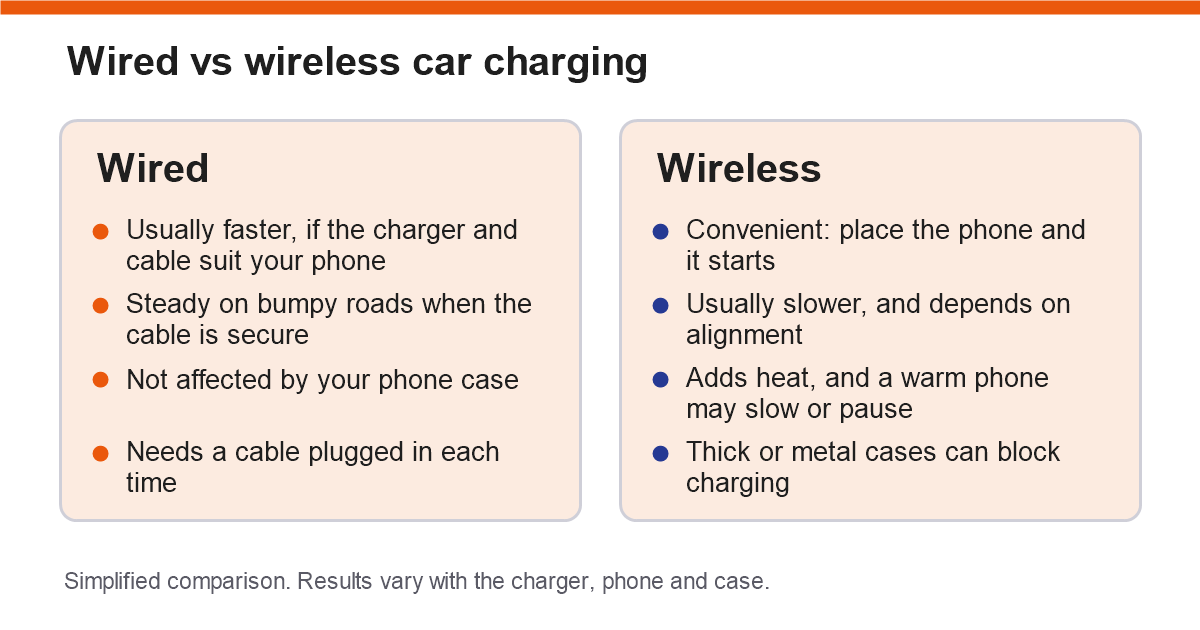
| Speed | Usually faster, if the charger and cable support your phone’s fast-charging method | Usually slower, and speed depends on alignment, case and heat |
| Convenience | You plug in a cable each time | Place the phone and it starts, if aligned |
| Heat | Phone can still warm up while charging and navigating | Tends to add heat, and a warm phone may slow or pause charging |
| Case | Not affected | A thick case or one with metal can block charging |
| Reliability on bumps | Good, if the cable is secure | Misalignment on bumpy roads can interrupt charging |
| Cost and parts | Charger plus a good cable | Often combined with a phone mount, with a charger plug still needed |
How wireless charging works, in plain terms
Qi is the common wireless charging standard, from the Wireless Power Consortium. A coil in the charger sends power to a coil in the phone over a short distance. Sources describe typical Qi power as roughly 5 to 15 watts. Because the coils must line up, a phone that sits slightly off-centre loses efficiency, charges slowly and makes more heat. Newer Qi2 chargers add magnets to help the phone sit in the right place.
- Alignment. Slight misplacement reduces efficiency and increases heat, according to an automotive supplier’s explanation. A magnetic ring helps keep the phone centred.
- Cases. Consumer guides say thick cases and cases with metal plates, wallets or ring holders can block or weaken charging. Thickness limits vary between sources, so check the charger’s stated limit.
- Heat. If the phone gets too warm, charging can slow or pause.
- Power source. A weak USB port or an underpowered plug feeding the wireless pad will limit speed.

How wired fast charging works
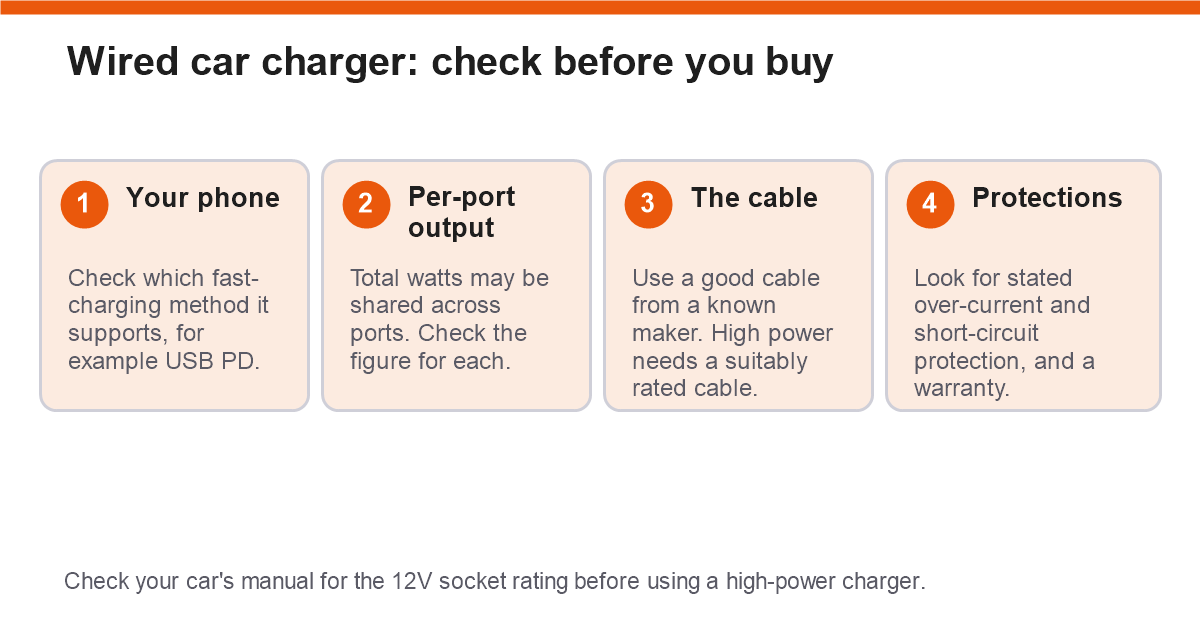
- USB Power Delivery (PD) is a common fast-charging method. The phone and charger agree how much power to send, so the phone only draws what it can take.
- Cables matter. A standard USB-C cable is generally limited to around 60 W, and cables for higher power need an electronic marker chip that reports a higher rating, according to explainers we read. For a phone, a good-quality cable from a known maker usually matters more than a very high rating.
- Total watts are shared. A charger marked with a high total may split it across ports, so two devices may each get less. Check the per-port figure.
- Match your phone. Check whether your phone supports PD or another fast-charging method, and choose a charger that does.
Safety and your car’s socket
- Check the charger’s current draw against the socket rating given in your car’s manual. Car sockets are usually protected by fuses, and not every socket suits every charger.
- Look for stated protections such as over-current, over-voltage and short-circuit protection from the maker.
- Avoid unbranded chargers with no stated specifications. Check the seller’s documents and warranty.
- Unplug high-power chargers if the car will sit for a long time, unless the socket is switched off with the ignition.
Heat in Indian conditions
A phone in direct sun on a dashboard, charging, running navigation and with the screen on, can get very hot. Heat is hard on batteries, and a phone that overheats may slow charging or dim the screen. Keep the phone out of direct sun where you can, use the AC vent if your mount allows, and avoid leaving a charging phone in a parked car. Wireless pads trap more heat against the phone, so they suit hot weather less well.
Which should you choose?
| Your situation | Worth considering |
|---|---|
| Long drives, heavy navigation use | Wired fast charger with a good cable |
| Short city trips, one-hand convenience | Wireless mount, if your case and phone suit it |
| Hot weather | Wired, and keep the phone out of direct sun |
| Rough roads | Wired with a secure cable, or a wireless mount with a firm magnetic hold |
| Several passengers charging | A multi-port charger, checking the per-port output |
Mistakes to avoid
- Buying on the biggest “watts” number without checking your phone supports it.
- Using a thick or metal-backed case with a wireless pad.
- Using a cheap cable that limits charging speed or overheats.
- Covering the charger or leaving a phone to cook in direct sun.
- Leaving a wireless mount where it blocks your view or an airbag zone.
Who may not need either
If your car has built-in USB ports or wireless charging that already works well, a separate unit may add little. A power bank can also be a simple backup.
A quick checklist before you buy
- Check which fast-charging method your phone supports.
- Decide between wired and wireless for how you drive.
- Check the charger’s per-port output and protections.
- Check your case works with a wireless pad.
- Pick a good-quality cable and check its rating.
- Check the warranty and the seller’s support.
Frequently asked questions
Is wireless charging in a car slower?
Usually, yes. Alignment, case and heat all reduce speed, so a wired charger is generally faster.
Will wireless charging damage my phone?
Qi charging is designed to be used with phones, but heat is hard on batteries, so avoid leaving a charging phone in direct sun.
Can I use any cable?
Many cables work, but a poor one can limit speed or overheat. Use a good-quality cable from a known maker, and check its rating if you want fast charging.
Can a car charger drain my battery?
If the socket stays powered when the engine is off, a charger with a phone attached can draw current. Unplug it, or use the socket only while the ignition is on.
Conclusion
Wired is the dependable choice for long drives. Wireless suits short trips if your phone and case are compatible. Check the heat, the socket and the cable before you spend on watts. When we add specific recommendations, they will be clearly labelled.
Related guides
- How to choose a car phone holder
- Dash cameras: what to look for before you buy
- Browse more in Car Electronics.
Sources
- Wireless Power Consortium: Qi wireless charging standard (general reference; we did not find the WPC’s own in-car guidance).
- Aptiv: What is the Qi standard in automotive (alignment, heat and Qi2).
- Explainers on USB Power Delivery and cable ratings, for example Digital Citizen and Belkin. These are secondary sources, so check the USB-IF specification for exact figures.
- Your car’s owner’s manual (12V socket rating) and your phone maker’s charging guidance.
- Vendor blogs were used for general case and heat advice. Thickness limits differ between them, so use the charger maker’s stated limits.