Researched buying guide. We have not tested the products or product types described here. Last reviewed: 15 November 2026.
A portable tyre inflator is one of the most practical things to keep in a car. The short answer: choose one with a gauge you can trust, a stated duty cycle, auto shut-off, the right power source, and a hose that reaches all four tyres.
Who this guide is for
- Drivers who want to top up tyres at home or on the road.
- People comparing 12V plug-in and cordless models.
Know your target pressure first
The correct pressure for your tyres is given by your vehicle’s manufacturer, usually on a placard or in the owner’s manual. It is not the maximum pressure printed on the tyre sidewall. Check pressure when the tyres are cold, which means before driving or after the car has been parked for a few hours, and check at least monthly and before long trips. Do not let air out of warm tyres to reach the target, because the reading drops as they cool. Your owner’s manual is the authority for your car.
What to look for
Power source
- 12V plug-in: no battery to charge, but the cable must reach every tyre and the socket must be able to supply the power the unit needs.
- Cordless: convenient, but limited by battery capacity.
Duty cycle
Duty cycle is how long the pump can run before it needs to cool. Listed figures vary between models. As examples taken from product listings, some are described as 25 minutes continuous and others as 15 minutes on and 15 minutes off. Treat these as examples only, and use the figure in your own unit’s manual. Do not exceed the stated duty cycle.
Gauge accuracy
Some sellers claim accuracy of about plus or minus 1 psi, while reviewers report that gauges can read differently from a separate gauge, especially as the unit heats up. Because claims vary, check the first few readings against a separate, trusted gauge.
Auto shut-off
Auto shut-off stops the pump at your preset pressure. Reviewers report that some units overshoot slightly, and that shut-off may not work reliably at very low pressures. Treat it as a convenience, not a substitute for checking.
Valve types and adapters
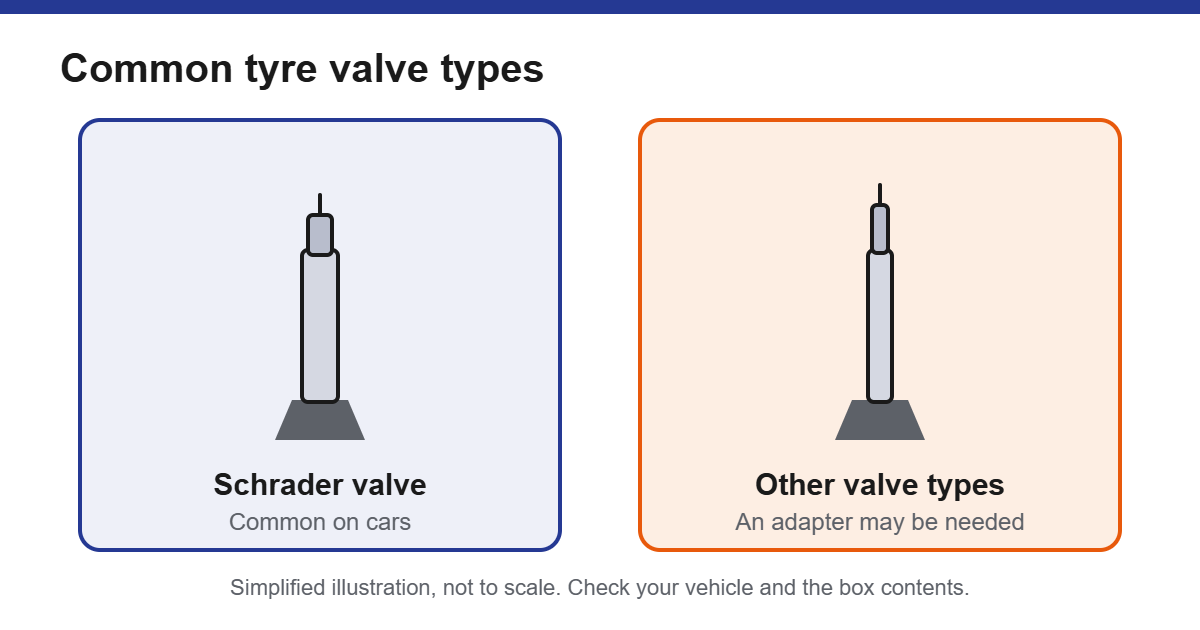
Most cars use Schrader valves. Some vehicles use other valve types and need an adapter. Check the box contents.
Units and display
Check whether the display shows psi, bar or both, and that it matches your vehicle’s placard.
Max pressure
A high maximum pressure does not tell you how good the unit is for everyday use. Speed, duty cycle and accuracy matter more for car tyres.
Light, storage and noise
A built-in light helps at night. Check the size and noise level if you will keep it in a small boot.
Which type suits you?
| Type | Good for | Watch out for |
|---|---|---|
| 12V plug-in | Keeping in the boot, no battery to charge | Cable must reach all four tyres, check your socket and fuse rating |
| Cordless (built-in battery) | Convenience, use away from the car | Battery capacity limits how many tyres you can fill |
| Cordless using a tool-battery platform | Owners who already have compatible batteries | Check compatibility with the exact battery you own |
Check the inflator’s current draw against the socket rating given in your car’s manual. Car sockets are usually protected by fuses, and not every socket suits every inflator.
How to use one safely
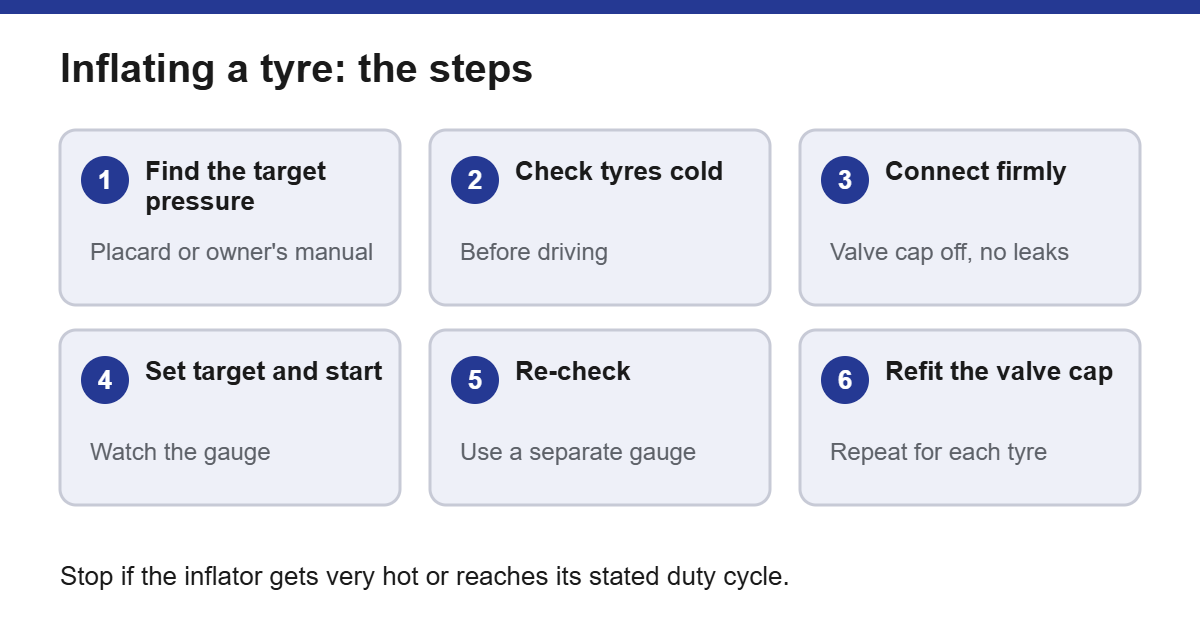
- Check your target pressure on the vehicle placard or in the manual, and note the units.
- Check tyres when they are cold, before driving or after the car has been parked for a while.
- Remove the valve cap and connect the inflator firmly, so air does not leak.
- Set the target pressure if your inflator has auto shut-off, and start the pump.
- Watch the gauge. Stop if the inflator gets very hot or you reach its stated duty cycle.
- Check the result with a separate gauge, then refit the valve cap.
- Repeat for each tyre, and check the spare if you have one.
If your car has a tyre pressure monitoring system, check the manual. Some systems need a short drive or a reset before the warning light clears.
Care and storage
- Keep it dry and coil the hose and cable loosely.
- Do not run it past its stated duty cycle.
- Check hoses, connectors and the cable for damage now and then.
- Store it where it will not roll around, and where heat will not build up.
Using one in India
- Find your pressure. We found no official Indian government or regulator guidance on car tyre pressure. Tyre-maker and car-site guides say the recommended pressure is usually on a sticker in the driver’s door frame or in the owner’s manual, and some cars also show it inside the fuel flap. Use the figure for your exact car, tyre size and load.
- Check the unit. Many Indian guides quote pressure in psi, but check the unit on your placard and on the inflator’s display, because they may not match.
- Heat. Tyre pressure rises as tyres warm up, especially on hot roads, so check and fill when the tyres are cold.
- Your 12V socket. Check that the inflator’s plug fits your car’s 12V socket and that the socket’s fuse rating covers the unit’s current draw. Check the product’s compatibility with your vehicle and tyre type.
- Two-wheelers. Scooters and motorcycles need different pressures from cars, often different front and rear and with a passenger or luggage. Use the figures in the bike’s manual, and check the inflator’s maximum pressure and valve adapters first.
Mistakes to avoid
- Inflating to the sidewall maximum instead of the vehicle placard.
- Ignoring duty cycle and overheating the pump.
- Trusting one gauge without a cross-check.
- Using a unit not suitable for your tyre type (for example, some compact models are not suited to larger light-truck tyres; check the specs).
- Leaving a damaged tyre inflated. An inflator is not a repair.
Who may not need one
- Drivers who always use a reliable garage or forecourt pump.
- Anyone with a damaged or leaking tyre, who needs a repair or replacement.
Checklist before you buy
- Find your vehicle’s recommended pressure and units.
- Choose plug-in or cordless.
- Check duty cycle, auto shut-off and valve adapters.
- Check the cable or hose reach to all tyres.
- Plan a separate gauge check.
Frequently asked questions
Can I use it on a motorcycle or bicycle?
Some inflators support other uses, but check the maker’s specifications and the correct pressures for those tyres. Use the bike’s own manual for motorcycle and scooter pressures.
How often should I check pressure?
Regularly, and before long trips. Follow your vehicle manual.
Can it inflate a completely flat tyre?
Often it can, but slowly, and the extra work may exceed the duty cycle. A flat tyre usually means damage, so inspect it, and get it repaired or replaced rather than relying on repeated inflation.
Is an inexpensive inflator good enough?
For occasional top-ups it may be, but duty cycle, gauge accuracy and build quality still matter. Check the specifications and cross-check the gauge.
Should I still carry a separate gauge?
It is a good idea. A separate gauge lets you check the inflator’s reading.
Conclusion
A trustworthy gauge, sensible duty cycle and the right power source matter more than headline pressure figures. We will add clearly labelled recommendations later.
Related guides
- Browse more in Car Travel & Utility.
Sources
- Your vehicle’s owner’s manual and the tyre information sticker on the door frame are the authority for your car’s pressure.
- Product reviews and retailer guides were used for common specification terms. Many are written by sellers or publishers that earn from sales, so use the manufacturer’s specification sheet for any exact figures.