Researched buying guide. We have not tested the products or product types described here. Last reviewed: 15 November 2026.
A portable jump starter can restart a car with a flat battery without a second vehicle. The short answer: choose one sized for your engine with some margin, check what protections it has, and read both its manual and your car’s manual before you connect anything.
Who this guide is for
- Car owners who want a way to restart the car without help, at home or on a trip.
- Drivers comparing jump starters with ordinary jumper cables.
- Anyone confused by peak amps, cranking amps and battery capacity on a listing.
What a jump starter does, and what it does not
A jump starter is a small battery pack with clamps. It gives your car a short burst of current to turn the engine over. It does not repair a dying battery or a faulty alternator. If the battery goes flat again soon after a jump, get the battery and charging system checked.
Sizing: match it to your engine
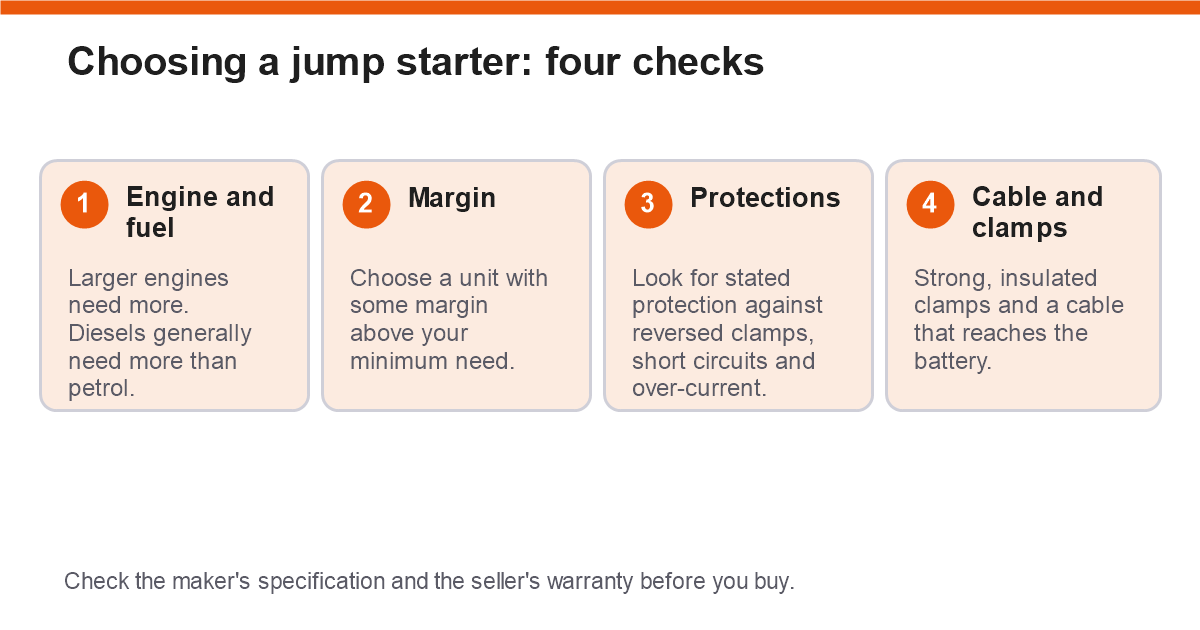
- Engine size and fuel. Larger engines need more starting current, and diesel engines generally need more than petrol engines of similar size. Seller guides suggest a range of ratings by engine size and also say you should not judge by engine size alone, so treat their tables as a rough guide, not a rule.
- Add some margin. One seller guide suggests choosing a unit with a good margin above your minimum need, since conditions are rarely ideal. Check your car’s manual or battery label for the battery’s cold cranking rating as a reference point.
- Ask the seller. A reputable seller should be able to tell you which engines the unit is meant for. If they cannot, be cautious.
Decode the numbers
| Term | What it usually means | Caution |
|---|---|---|
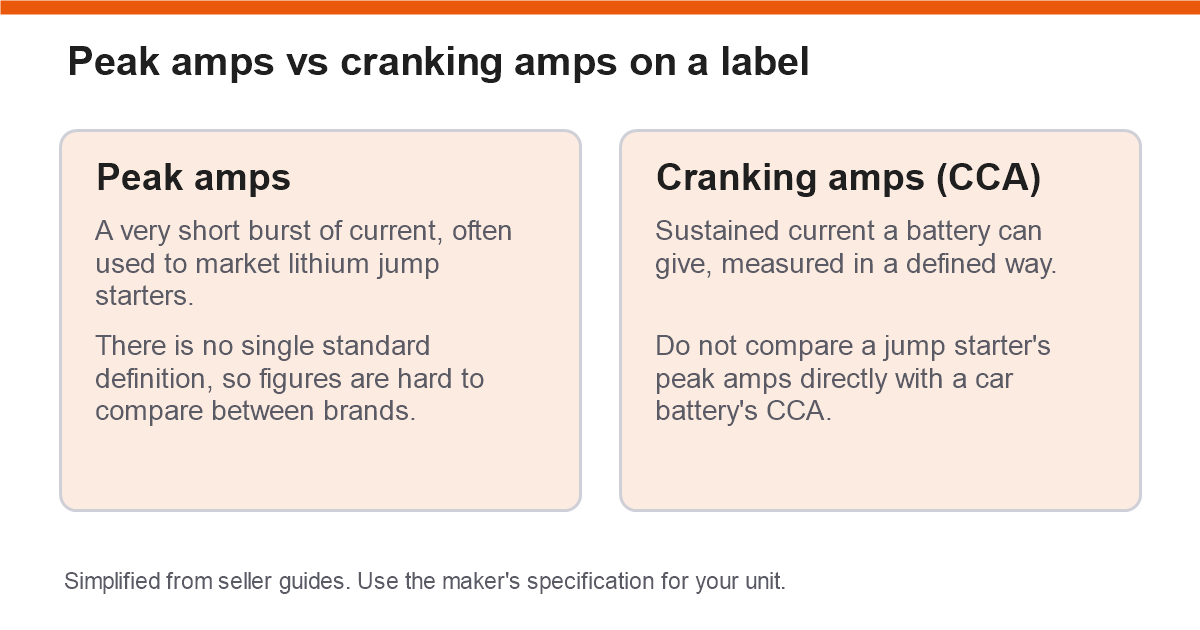
| Peak amps | A very short burst of current, used to market lithium jump starters | There is no single standard definition, so figures are hard to compare between brands. |
| Cranking amps / CCA | Sustained current a battery can give, measured in a defined way (CCA is an SAE J537 measurement, according to one seller guide) | Do not compare a jump starter’s peak amps directly with a car battery’s CCA. |
| Capacity (mAh or Wh) | How much energy the pack holds | A bigger number means more jumps or phone charges per charge, not necessarily a stronger start. |
Lithium or lead-acid?
- Lithium packs are small and light and often double as power banks. They need more care with heat, damage and charging.
- Lead-acid units are bulkier and heavier. Some sellers describe them as better at handling high current, but check the product’s own specifications.
Safety features to look for
- Protection against reversed clamps, short circuits and over-current. These should be stated by the maker, not just implied.
- Clear cranking-time limits in the manual. Some lithium makers set a short limit on each attempt and require a rest between attempts. Follow your unit’s manual, not a general rule.
- Strong, insulated clamps and a cable long enough to reach the battery.
- Clear indicators for battery level and connection status.
- Seller documents. We could not confirm an Indian certification requirement for jump starters, so ask the seller for the maker’s safety documents and check the warranty terms.
Using one safely
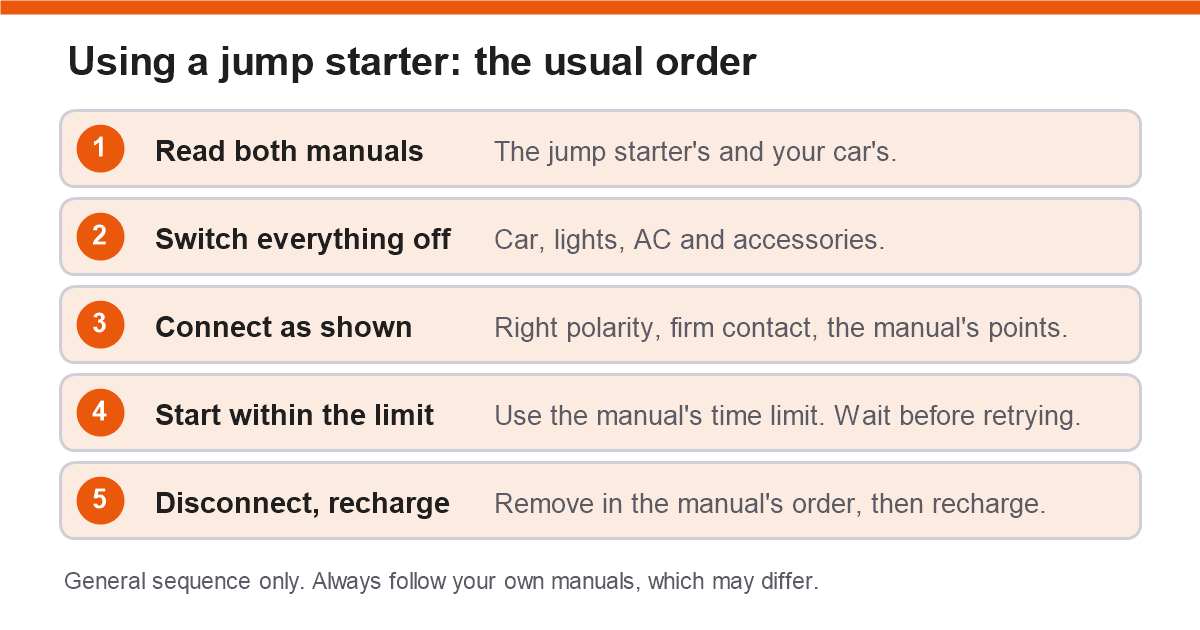
- Read both the jump starter’s manual and your car’s owner’s manual. Some cars specify the jump-start points, or warn about sensitive electronics.
- Switch off the car, lights, AC and accessories.
- Connect as the manual describes, with the correct polarity and a firm contact.
- Start the car within the time the manual allows. If it does not start, wait as the manual instructs rather than trying repeatedly.
- Disconnect in the order the manual gives, and recharge the unit afterwards.
Storage and care in Indian heat
- Follow the maker’s advice on where to store it. A closed car parked in strong sun can get very hot, and heat is hard on lithium batteries, so avoid leaving a unit on the dashboard.
- Recharge it on the schedule the maker suggests, even if you have not used it, since packs lose charge over time.
- Check the clamps and cable for damage, and stop using a pack that is swollen, dented or damaged.
Mistakes to avoid
- Buying on the biggest “peak amps” number alone.
- Using a unit that is too small for a large diesel engine.
- Connecting the clamps the wrong way round or to a place the manual does not allow.
- Leaving the pack in a hot car for months and never recharging it.
Who may not need one
- Drivers who already have roadside assistance and rarely drive alone, or far from help.
- Drivers whose battery is old. A new battery may be a better investment than a jump starter.
A quick checklist before you buy
- Note your engine size, fuel type and battery rating.
- Choose a unit with a margin above your needs.
- Check the stated protections and the manual’s cranking limits.
- Check the cable length and clamp quality.
- Check the warranty and the seller’s support.
Frequently asked questions
Can I use it on a motorcycle?
Only if the maker says it is suitable. Many units are designed for cars. Check the manual and the unit’s stated range.
How many times can I use it before recharging?
It depends on the unit, the engine and the conditions. The maker’s specification is the only reliable guide.
Is it better than jumper cables?
It does not need a second vehicle, which is the main advantage. Cables are cheaper and have no battery to maintain, but you need someone else’s car.
Can a jump starter damage my car?
Misuse can, for example reversed polarity or connecting to the wrong point. Follow both manuals.
Conclusion
Match the unit to your engine, favour clearly stated protections over big numbers, and read both manuals before you connect it. When we add specific recommendations, they will be clearly labelled.
Related guides
- Portable tyre inflators: complete buying guide
- Browse more in Car Travel & Utility.
Sources
- Your car’s owner’s manual and the jump starter’s own manual are the authority on connection points, cranking limits and safety.
- Seller guides were used for general terms and sizing ideas, for example WOLFBOX, Lectron and Tyrebay Direct. They are sellers, and their figures differ, so use the maker’s specification for your unit.