Researched buying guide. We have not tested the products or product types described here. Last reviewed: 15 November 2026.
A helmet is the most important piece of riding gear you will buy. The short answer: choose one that fits your head properly, make sure it carries the ISI mark that Indian law requires, and replace it after a crash.
Who this guide is for
- New riders buying a first helmet.
- Riders in India who want to know what the helmet law and the ISI mark actually require.
- Riders replacing an old helmet.
Start with fit
A helmet that does not fit well cannot protect you properly, whatever its certification. Fit comes before price, graphics or features.
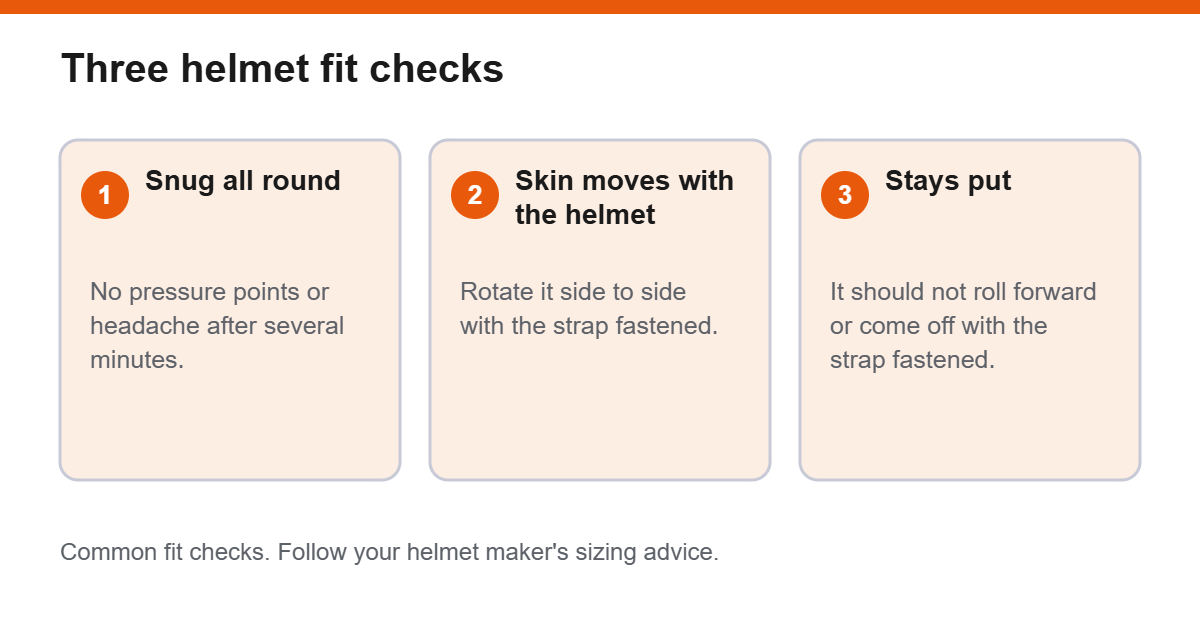
These are commonly published fit checks. Individual makers may give their own advice, so follow their sizing guidance.
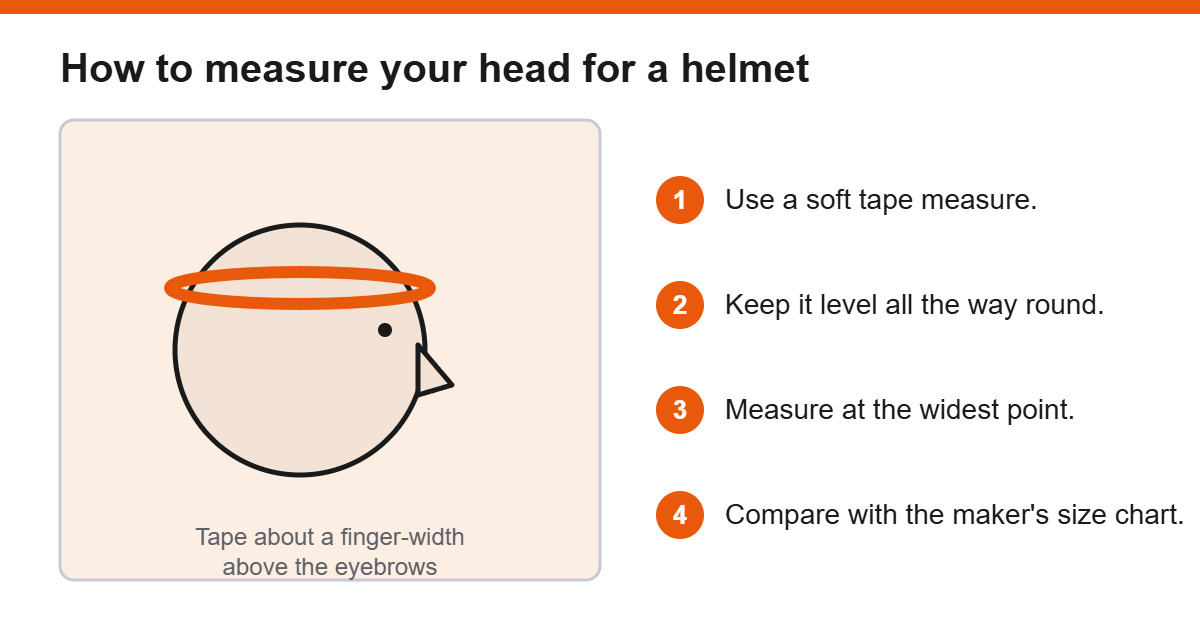
- Measure your head. Wrap a soft tape around your head about a finger-width above your eyebrows, at the widest point, and compare the result with the maker’s size chart.
- Try it on with the strap fastened and keep it on for several minutes. It should be snug all round, with no pressure points or headache.
- Move your head side to side. The helmet should move your skin with it rather than slide over it.
- Check it does not roll off. With the strap fastened, it should not rotate forward or come off when you try to roll it off from the back.
- Check your view to the sides, and test with glasses if you wear them.
Heads vary in shape, from rounder to more oval, and some helmets suit one shape better. If one brand feels uncomfortable in the same size as another, shape may be the reason, so try more than one. If you are between sizes, ask the shop for advice.
Check the ISI mark and the law in India
In India, two things work together. The Motor Vehicles Act says you must wear a protective helmet, and a separate government order says which helmets may be made and sold. Check both before you buy.
The law: Sections 129 and 194D
- Who must wear one: Section 129 of the Motor Vehicles Act, 1988 says every person above four years of age who is driving, riding or being carried on a motorcycle must wear protective headgear in a public place. The headgear must conform to standards set by the Central Government, and the section’s explanation describes it as securely fastened to the head with its straps. Wearing a helmet unfastened is not what the law has in mind, and it is not safe.
- Exemption: the section does not apply to a Sikh person wearing a turban.
- Penalty: Section 194D, added by the 2019 amendment, provides a fine of one thousand rupees and disqualification from holding a driving licence for three months. Check how your state’s traffic police apply and collect it.
The standard: IS 4151:2015 and the ISI mark
- The order: the Ministry of Road Transport and Highways issued the Helmet for Riders of Two Wheeler Motor Vehicles (Quality Control) Order, 2020 (S.O. 4252(E), dated 26 November 2020). It came into force on 1 June 2021 and covers helmets made to IS 4151:2015.
- What it means for you: goods covered by the order must carry the BIS Standard Mark (the ISI mark) under a licence from the Bureau of Indian Standards. In practice, a helmet sold for road use in India should carry the ISI mark.
- What to look for: the ISI mark, the standard number IS 4151 on the helmet, and the BIS licence number. Ask the seller to show the licence number if you are unsure. BIS has said consumers can check a manufacturer’s credentials through the BIS Care app or the BIS website.
- Imported helmets: an ECE or DOT label does not replace the ISI mark. Ask the seller for the BIS licence number, and do not rely on a helmet that has no ISI mark.
Children and pillion riders
- Section 129 covers anyone above four years of age, so a pillion passenger needs a helmet of their own.
- For a child under four, Rule 138(7) of the Central Motor Vehicles Rules, 1989 (added in 2022) requires a safety harness that attaches the child to the rider. Press reports on the rule also describe a child’s crash helmet and a 40 km/h speed limit. We could not confirm those two details in the rule text, so read the notified rule before you rely on them.
Choose a helmet type
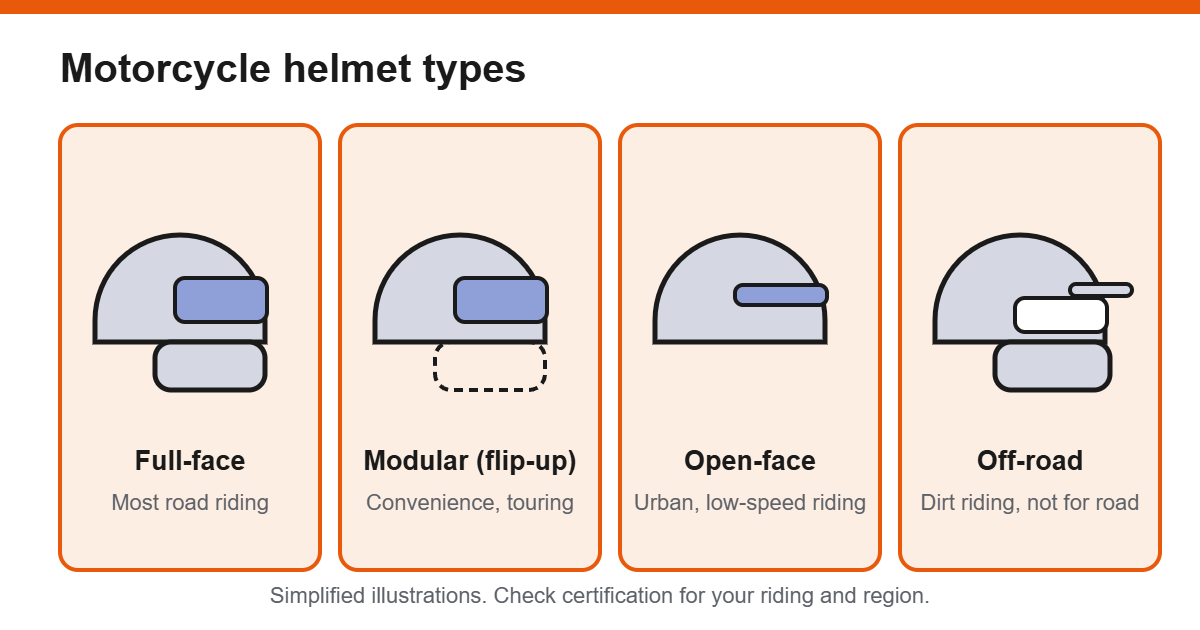
| Type | Good for | Consider |
|---|---|---|
| Full-face | Most road riding, coverage and noise | Warmer in hot weather |
| Modular (flip-up) | Convenience, touring | Heavier, check the chin-bar certification |
| Open-face (three-quarter) | Urban and low-speed riding | Less facial protection |
| Off-road | Dirt riding | Not designed for road use |
Choosing by how you ride
| Riding | Features worth weighing |
|---|---|
| City commuting | Ventilation, weight, a visor that is easy to operate |
| Touring | Comfort over long periods, wind noise, ventilation, a sun visor or tinted option |
| Sport riding | Stability at speed, secure retention, a close fit |
| Adventure or dual-sport | Ventilation and a peak, but check it is certified for the use you intend |
Wind noise can be tiring on long rides. Many guides suggest ear protection, and noise levels vary between helmets and with your bike and screen. If you ride in hot weather, ventilation and a light helmet matter more than you might expect.
Visor, strap and extras
- Check visor clarity, field of view and how it opens, closes and locks. Replacement visors should be made for your exact helmet.
- Scratched visors hurt visibility, especially at night or in low sun. Dark tints can be hard to see through at night, and rules on visor tint differ by country.
- Check the strap type, and whether you can fasten it easily with gloves on.
- If you plan to fit a communication system or wear glasses, check compatibility before you buy.
When to replace a helmet
- After a crash: replace it if the helmet took a hard impact, even if it looks undamaged. The internal foam can be damaged without visible signs.
- By age: makers set their own guidance. Five years is often cited as a conservative benchmark, but follow your helmet maker’s instructions.
- Do not buy a used helmet, because you cannot know its history.
Looking after your helmet
- Clean it as the maker advises, usually with mild soap and water. Avoid solvents, stickers or paint unless the maker says they are safe.
- Store it somewhere cool and out of direct sun, and avoid hanging it on a mirror or handlebar.
- Many helmets have a label inside with the manufacture date, sometimes under the padding.
Red flags when shopping
- No ISI mark, or a mark you cannot match to IS 4151:2015.
- A very light helmet with almost no padding inside, even if it has a sticker.
- Novelty or costume helmets that are not designed for road use.
- Unusually cheap helmets from sellers who cannot explain the certification.
- Buying online without a return policy, which makes it hard to fix a poor fit.
A quick checklist before you buy
- Measure your head and check the size chart.
- Find the ISI mark and the IS 4151 marking.
- Choose the type that suits your riding.
- Try it on for several minutes.
- Check the maker’s replacement guidance.
Frequently asked questions
Is an ECE or DOT helmet legal in India?
Do not count on it. Indian rules tie helmets to IS 4151:2015, and the quality control order requires the ISI mark. An ECE or DOT label does not replace it. Ask the seller for the BIS licence number.
Is a more expensive helmet safer?
Not automatically. Fit and certification matter most, and higher prices often pay for comfort, weight and features.
Does a passenger need their own helmet?
Yes. A passenger needs a properly fitted, certified helmet of their own. In India, Section 129 covers pillion riders above four years of age, and children under four have their own harness rule.
Can I wear glasses with a helmet?
Many helmets allow for glasses, but check the fit and the arms of your glasses with the helmet on.
Conclusion
Fit first, then the ISI mark, then type and features. Replace your helmet after a crash and follow the maker’s guidance on age.
Related guides
- Browse more in Riding Gear.
Sources
- Bureau of Indian Standards: IS 4151:2015, protective helmets for motorcycle riders (standard record, mandatory certification from 1 June 2021).
- Motor Vehicles Act, 1988, Sections 129 and 194D, and the 2020 helmet quality control order, as quoted in the Bombay High Court judgment Project Revolt LLP v. Bureau of Indian Standards. Check the official text on the India Code portal.
- Ministry of Road Transport and Highways: Helmet for Riders of Two Wheeler Motor Vehicles (Quality Control) Order, 2020, S.O. 4252(E).
- Central Motor Vehicles (Second Amendment) Rules, 2022, Rule 138(7), as reported by SCC Online.
- Fit and care advice comes from commonly published maker and retailer guides. Follow your own helmet maker’s instructions.