Researched buying guide. We have not tested the products or product types described here. Last reviewed: 15 November 2026.
A jacket is the layer between your skin and the road, so it matters more than its looks. The short answer: choose one that carries a clear protection class on its label, has armour at the shoulders and elbows, fits snugly without restricting you, and suits India’s heat and monsoon so that you actually wear it every ride.
Who this guide is for
- Riders buying a first proper riding jacket for commuting, weekends or touring.
- Riders who see “CE armour” or “Level 2” on a listing and want to know what it means.
- Anyone choosing between a mesh, textile or leather jacket for Indian weather.
Do you have to wear one?
The Motor Vehicles Act, 1988 requires a protective helmet for riders and pillion passengers (Section 129; see our helmet guide). In the sources we checked, we found no rule that requires a riding jacket, so a jacket is your own safety choice. That makes the label and your own judgement more important, because no Indian standard stands behind the claim on a listing.
Read the protection class on the label
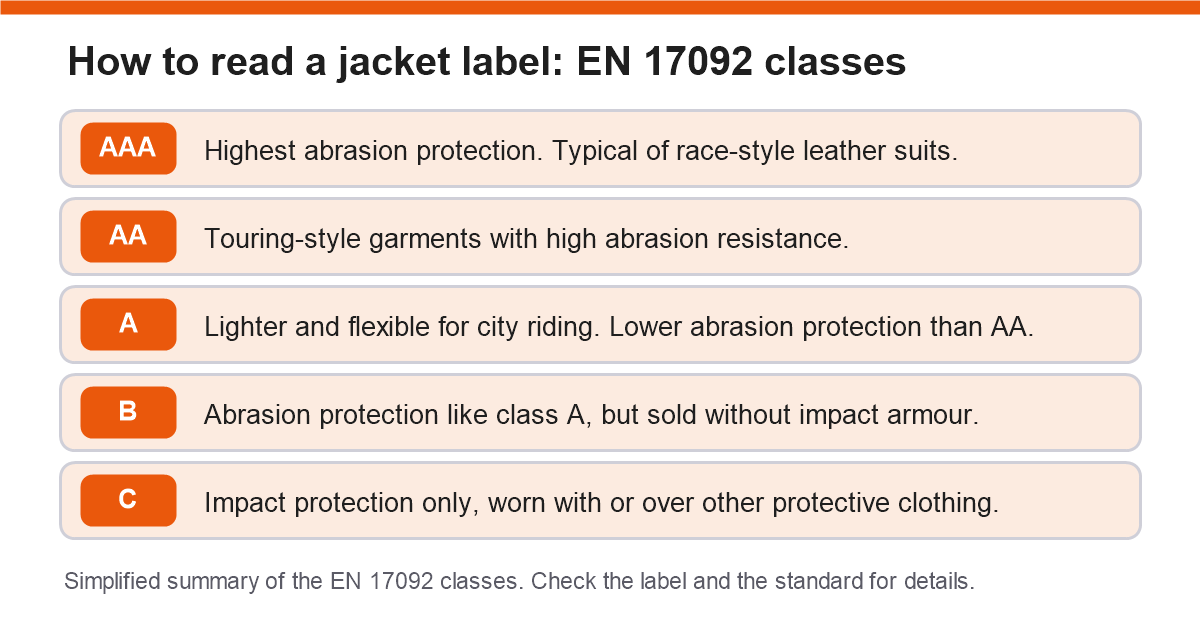
The European standard EN 17092 is the one most riding jackets are measured against. It sorts garments into classes, and the class tells you what the jacket was tested to do. According to testing body SATRA, the standard’s Part 1 sets the test methods, and the other parts set the requirements for each class.
| Class | What it means, in plain terms |
|---|---|
| AAA | Highest abrasion protection. Typical of race-style leather suits. |
| AA | Touring-style garments with high abrasion resistance. |
| A | Lighter, more flexible garments for city and casual riding, with lower abrasion protection than AA or AAA. |
| B | Abrasion protection like class A, but sold without impact armour. |
| C | Impact protection only, designed to be worn with or over other protective clothing. No minimum abrasion protection. |
Check that the label shows the standard (EN 17092), the class and, ideally, the part number. A listing that only says “CE” or “heavy duty” does not tell you the class. We have not repeated the test thresholds here, because the figures differ between retailer guides. Read the standard or the label if you need exact numbers.
Check the armour
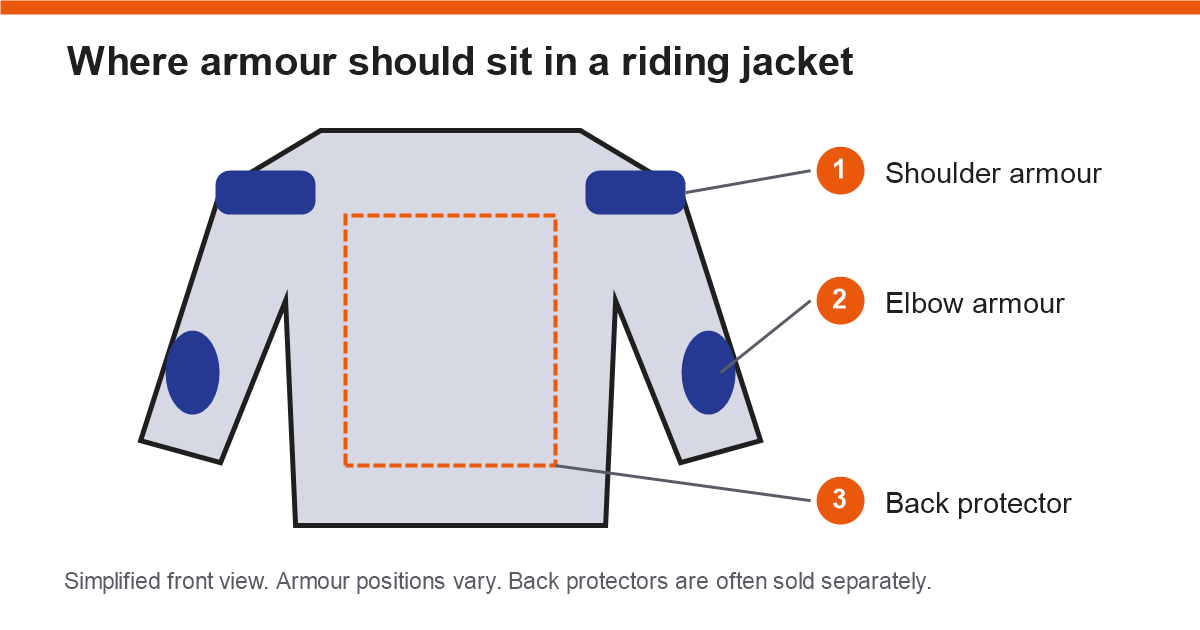
- Where it sits. Shoulders and elbows are the basics. Many jackets also take a back protector, and some sell it separately.
- Levels. Limb armour is tested under EN 1621-1, which has Level 1 and Level 2. SATRA describes the two levels, and Level 2 is the higher one. Sources quote different test figures for each level, so we do not repeat them.
- Back protectors are tested under a separate part of the standard (EN 1621-2), so a jacket that only has foam padding in the back is not the same as one with a certified back protector.
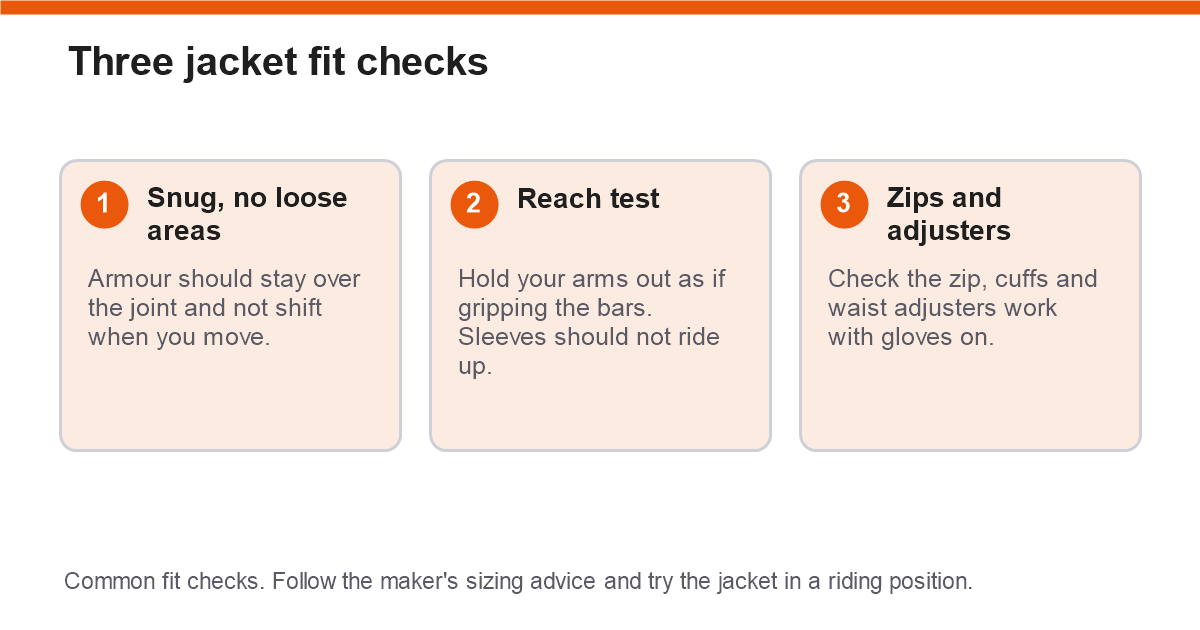
- Fit of the armour. Armour only helps if it stays over the joint. Try the jacket on, move your arms as if gripping the bars, and check the elbow pads do not slide around.
Choose the material for Indian weather
| Type | Good for | Watch out for |
|---|---|---|
| Mesh | Hot, humid weather and city riding | Little weather protection. Check the class and the armour, not only the airflow. |
| Textile with vents and liners | All-year commuting and touring, since liners can be added or removed | Can be warm if vents are small. Check the waterproof liner is removable. |
| Leather | Strong abrasion resistance, sport riding | Heavy and hot in summer. Needs care after rain. |
| Adventure or touring jacket | Long rides in changing conditions | Bulky for short city trips. |
Much of India is hot and humid for large parts of the year, and the monsoon brings heavy rain, so a jacket you leave at home because it is too hot is no protection at all. Many riders in these conditions choose a ventilated jacket with a removable waterproof liner, or a separate rain layer. Dry wet jackets away from direct heat, and follow the care label.
Fit and comfort
- It should be snug, with no loose areas where armour can shift, but not so tight that it pulls when you reach for the bars.
- Sit on a bike if you can, or mimic the riding position, and check the sleeves do not ride up.
- Check the collar, cuffs and waist adjusters, and that the zip works with gloves on.
- Look for reflective panels or bright colours if you ride at dusk or at night.
When to replace a jacket
- After a crash, because armour and stitching can be damaged without visible signs.
- When seams, zips or the outer fabric are worn or torn.
- If the armour has hardened, cracked or flattened.
Mistakes to avoid
- Buying on style or a “CE” mention alone, without checking the class.
- Choosing a jacket so loose that the armour shifts.
- Assuming armour in the listing photo is included. Check what is in the box.
- Wearing a fashion jacket or a plain jacket instead of riding gear.
Who may not need a new jacket
If your current jacket has a labelled class, armour that still fits properly and no damage, a new one may add little. Spending on a back protector or better gloves may protect you more.
A quick checklist before you buy
- Find the EN 17092 class on the label.
- Check which armour is included and where it sits.
- Choose a material for your climate and your riding.
- Try it on in a riding position.
- Check the seller’s return policy.
Frequently asked questions
Is a jacket legally required in India?
In the sources we checked, the law requires a helmet (Section 129 of the Motor Vehicles Act) but we found no rule requiring a jacket. It is still one of the most useful pieces of gear you can wear.
Does “CE” mean the jacket is safe?
Not by itself. The class on the label and the armour level tell you much more. If a listing shows no class, ask the seller.
Is a mesh jacket safe?
It depends on its class and armour. A mesh jacket with a stated class and armour is a better choice than a fashion jacket, and it is far more comfortable in summer.
Do I need a back protector?
Many riders add one. If your jacket has a pocket for it, check whether the protector is included or sold separately, and whether it is certified.
Can I wash a riding jacket?
Follow the care label. Remove the armour first, and avoid harsh chemicals or direct heat unless the maker says they are safe.
Conclusion
Look for the class on the label first, then the armour, then the material that suits your weather. When we add specific recommendations, they will be clearly labelled.
Related guides
- How to choose the right motorcycle helmet
- Motorcycle riding gloves: features to consider
- Browse more in Riding Gear.
Sources
- SATRA: EN 17092, protective clothing for motorcycle riders (classes and test methods).
- SATRA: EN 1621, impact protectors for motorcycle riders (Level 1 and Level 2).
- Motor Vehicles Act, 1988, Section 129 (protective headgear), as quoted in the Bombay High Court judgment Project Revolt LLP v. Bureau of Indian Standards.
- Retailer and maker guides were used for general fit and care advice. They are commercial sources, so rely on the maker’s label and the standard for exact figures.