Researched buying guide. We have not tested the products or product types described here. Last reviewed: 15 November 2026.
Your hands take a lot of the force in a fall, so gloves are worth getting right. The short answer: look for gloves certified to a recognised standard, make sure they fit snugly without restricting movement, and match the style to your weather and riding.
Who this guide is for
- New riders buying their first pair.
- Riders who want to understand protection levels and markings.
Protection standards: EN 13594
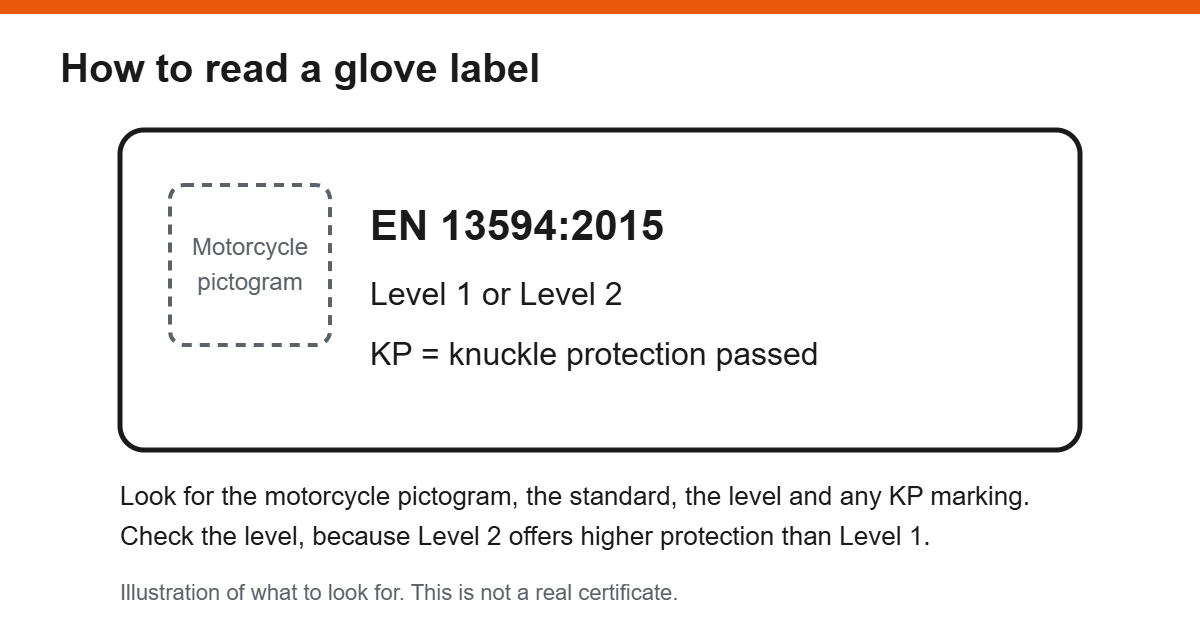
Motorcycle gloves sold in India are often labelled to EN 13594:2015, a European standard that gives riders a common way to compare protection. It has two levels. Level 1 is for gloves designed to keep protection while keeping ergonomic penalties low. Level 2 is for gloves with higher protection. According to testing body SATRA, impact protection on the knuckles is optional at Level 1 and mandatory at Level 2. A “KP” marking indicates knuckle protection. According to SATRA, the standard also sets a minimum cuff length (5 mm at Level 1 and 50 mm at Level 2) and a minimum pull-out force for the wrist or cuff restraint (25 N at Level 1 and 50 N at Level 2). Retailer and maker guides quote other test figures that differ from each other, so we have not repeated them. Check the full standard if you need exact numbers.
The label should show a motorcycle pictogram, the standard, the level and any KP marking. Where gloves have no mandatory standard, judge protection from the construction and from any certification the maker states.
What to check
Fit
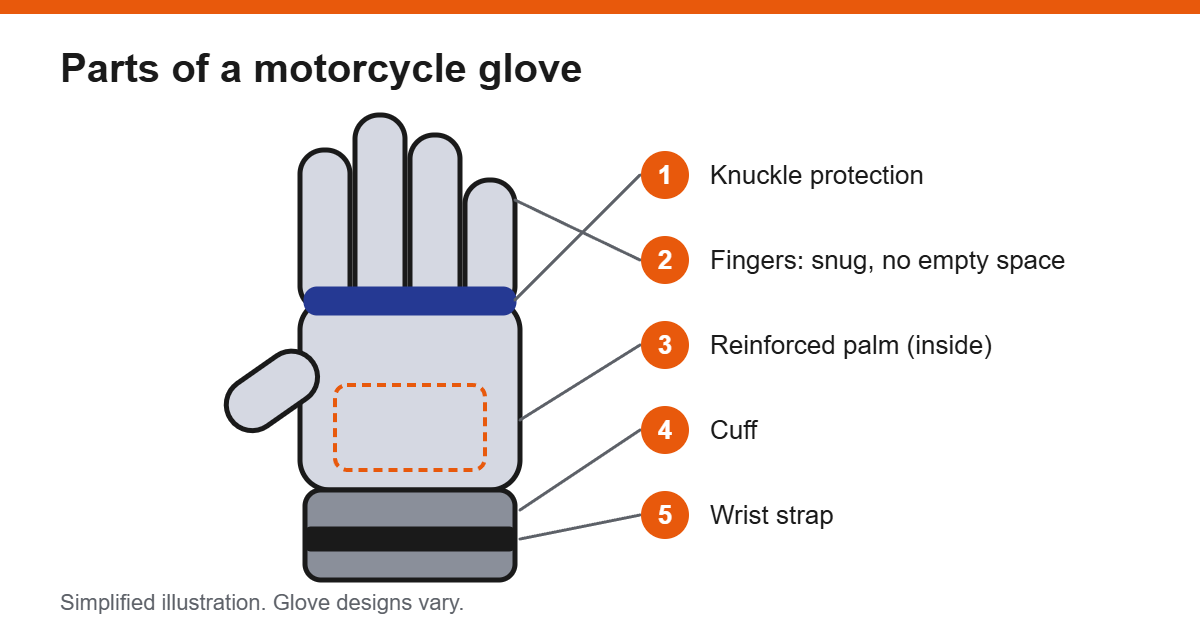
Gloves should be snug without squeezing, with no excess material at the fingertips, and should let you operate the controls comfortably. Sizing differs between brands, so try them with your hands in a riding position.
Materials and construction
- Leather generally offers strong abrasion resistance.
- Textile gloves can be lighter or more flexible, with protection depending on construction.
- Look for reinforced palms and protection on the knuckles and fingers.
Cuff and wrist retention
A longer gauntlet can protect more of the wrist and sit over a jacket sleeve. A wrist strap helps keep gloves on in a fall.
Season and weather
- Summer gloves emphasise ventilation.
- Winter gloves add insulation and weather protection.
- If you ride in rain often, consider waterproof designs, or a separate rain cover.
Touchscreen tips
Touchscreen-compatible fingertips are convenient, but check how well they work in practice.
Glove types by riding
| Type | Good for | Consider |
|---|---|---|
| Sport | Fast road riding | Higher protection, longer cuff, snug fit |
| Touring | Long rides in varied weather | Comfort, weather protection, cuff that fits over a jacket sleeve |
| Adventure | Mixed road and light off-road riding | Protection with flexibility |
| Urban or commuter | Short everyday trips | Easy to wear, but check the protection level |
| Summer or mesh | Hot weather | Ventilation, and check the protection and certification |
| Winter | Cold or wet weather | Insulation, waterproofing, and keeping enough feel for the controls |
How to size and test
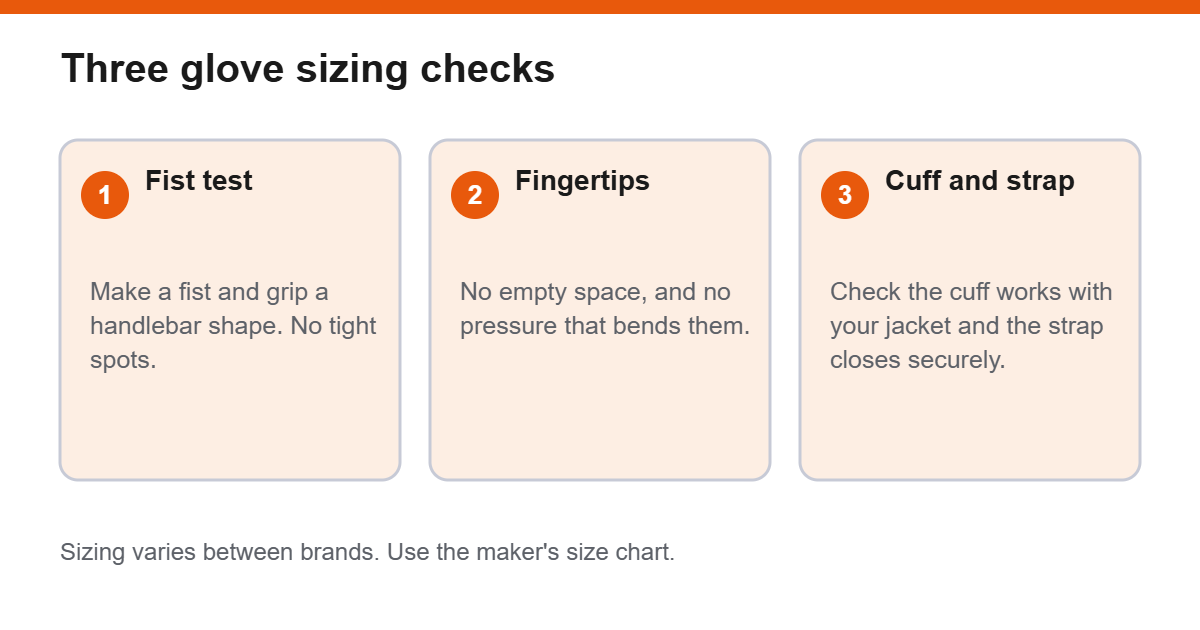
- Use the maker’s size chart, since sizing varies between brands.
- Try gloves on and make a fist, then grip a handlebar or a similar shape.
- Check fingertips: there should be no extra space, and no pressure that bends them.
- Check that seams are not pressing on your hand.
- Check that the cuff works with your jacket, and that the wrist strap closes securely.
- Try operating a lever if you can, to be sure you can move your fingers freely.
Cold and wet
Cold hands lose feel and slow down your reactions, which affects control. Waterproof gloves keep water out but may breathe less. If you ride in cold or wet weather often, consider insulation, waterproofing, or a second pair for different weather.
Care and replacement
- Follow the care label. Dry gloves away from direct heat.
- Treat leather as the maker advises.
- Replace gloves after a crash, and when palms wear thin, stitching splits or the fit loosens.
Gloves in India: what applies and what to check
The Motor Vehicles Act requires a protective helmet for riders and pillion passengers (Section 129). In the sources we checked, we found no equivalent rule requiring riding gloves, so gloves are your own safety choice. We also searched the Bureau of Indian Standards pages and found no standard or mandatory certification for motorcycle riding gloves. Absence from a search is not proof, so check the BIS standards search yourself.
- The label is your evidence. With no Indian standard to check, look for the EN 13594 pictogram, the level and any KP marking on the glove itself, not only in the online listing. Ask the seller if the label is missing.
- Heat and humidity. Much of India is hot and humid for large parts of the year, so airflow matters. Perforated leather or mesh gloves with a reinforced palm, knuckle protection and a stated level give airflow without giving up all protection. Plain fabric, cycling or work gloves are not designed for a fall.
- Monsoon. If you ride through heavy rain, consider waterproof gloves or a rain cover. Dry wet gloves away from direct heat, as the care label advises.
- Buying online. Sizing differs between brands, so check the size chart and the return policy before you order.
Whatever the label says, also look at the construction: palm reinforcement, knuckle protection, a secure wrist closure, and the maker’s stated testing.
Mistakes to avoid
- Choosing on style alone.
- Buying gloves that are too loose or too tight.
- Assuming a certification mark means maximum protection. Check the level and whether it includes knuckle protection.
- Wearing worn or damaged gloves.
Who should be careful
- Riders on fast roads or long trips may want Level 2 gloves with knuckle protection and a longer cuff.
- Riders in hot weather should not assume mesh gloves protect as well as heavier ones. Check the level and knuckle protection on the label.
- Anyone buying uncertified gloves should look closely at the palm, stitching and wrist closure, since there is no label level to go by.
Checklist before you buy
- Look for a recognised standard on the label.
- Check the level and KP marking.
- Try them on with a gripping motion.
- Choose a cuff length and season to suit you.
- Check care instructions.
Frequently asked questions
Do I need Level 2 gloves?
Level 2 offers higher protection. Whether you need it depends on your riding and budget, but it is a sensible thing to compare.
Can I use work or cycling gloves?
They are not designed for motorcycle falls, so a motorcycle glove is better.
Are more expensive gloves better?
Not automatically. Fit, protection level and suitability for your weather matter more than the price.
Do I need a long cuff?
A longer cuff covers more of the wrist and can sit over a jacket sleeve. Riders who ride at higher speeds, or want more protection, may prefer it.
Should I buy gloves online?
It is possible, but sizing is harder. Check the size chart and the return policy.
Conclusion
Choose certified gloves that fit well and suit your weather. When we add recommendations, they will be clearly labelled.
Related guides
- Browse more in Riding Gear.
Sources
- SATRA: EN 13594:2015.
- Motor Vehicles Act, 1988, Section 129 (protective headgear for riders and pillion passengers). We found no glove requirement in the sources we checked.
- Retailer and glove-maker guides on CE markings were used for general explanation; they are commercial sources and some figures differ, so check the standard itself.
- Bureau of Indian Standards: Know Your Standards search, where we looked for a glove standard and found none (we found IS 4151:2015 for helmets).