Researched guide. We have not tested the products or product types described here. Last reviewed: 16 November 2026.
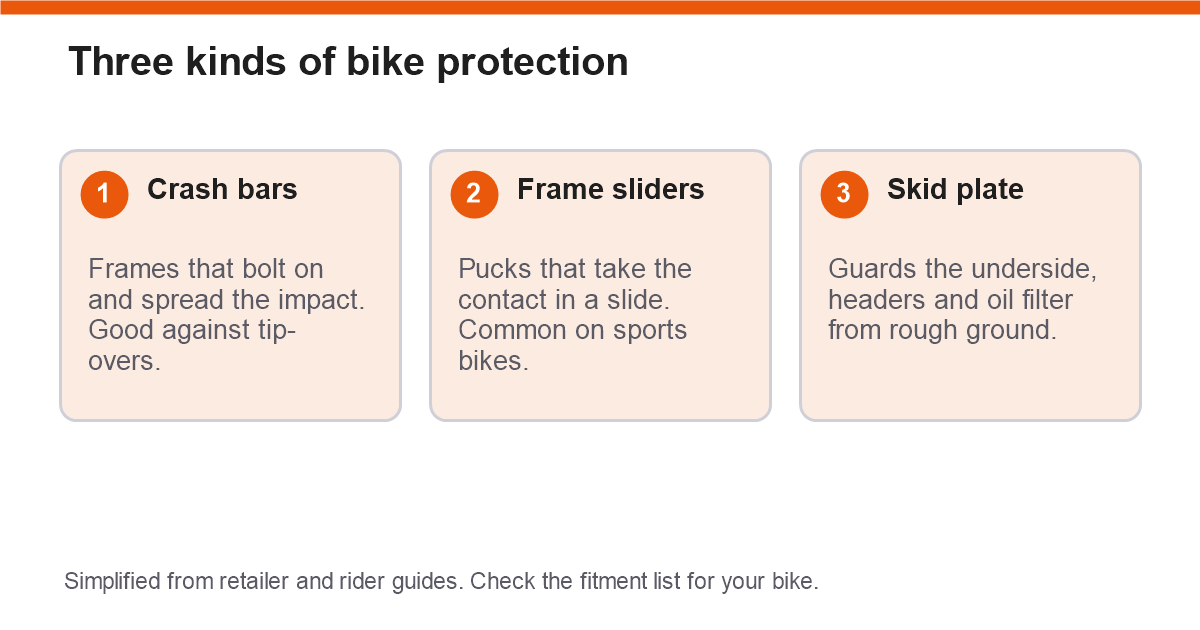
Crash guards, frame sliders and skid plates are often lumped together, but they do different jobs. The short answer: crash bars protect the bike from tipping and low-speed falls, sliders are sacrificial pucks for slides, and a skid plate protects the underside. Choose by your bike and how you ride, check the maker’s fitment list, and check the rules in India before you fit anything fixed to the frame.
Who this guide is for
- Owners thinking about protecting the bike from low-speed falls and tip-overs.
- Riders comparing crash bars, sliders and skid plates.
- Anyone unsure whether fitting guards affects insurance, warranty or the law.
The three, side by side
| Type | What it is | What it protects | Watch out for |
|---|---|---|---|
| Crash bars or engine guards | Tubular steel or aluminium frames that bolt to the bike’s frame or engine mounts | Spread the impact over a wider area and help protect fragile parts such as the radiator, tank and engine covers | Fitting varies. Some may need changes to original parts, and some may limit access for routine work. |
| Frame sliders | Compact pucks, usually plastic or composite, mounted to frame or engine mounts | Give a sacrificial contact point in a slide. Common on sports and naked bikes. | Model-specific. Can dig in on loose ground. High-speed slides can wear a slider down quickly. |
| Skid plate or sump guard | A plate under the engine | Protects the underside, exhaust headers and oil filter from rocks and rough ground | Adds weight. Check it does not trap mud or block airflow. |
Which suits your bike?
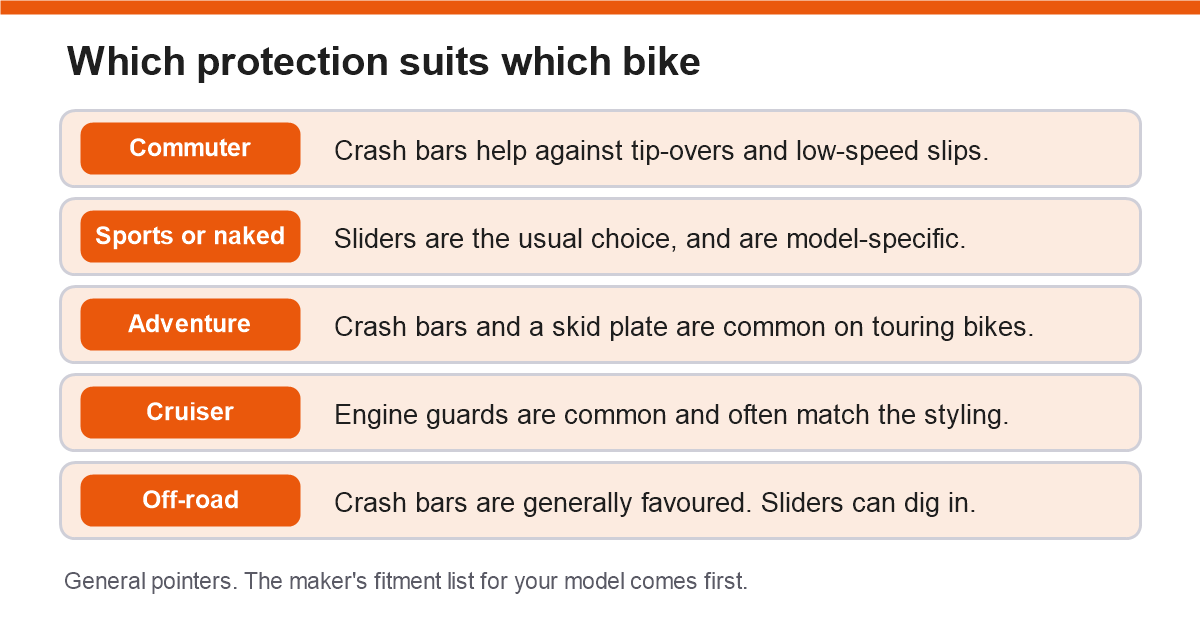
- Commuter or city bike. Crash bars can help protect against tip-overs in parking and low-speed slips.
- Sports or naked bike. Sliders are the usual choice, and are generally model-specific.
- Adventure or touring bike. Crash bars and a skid plate are common, and crash bars are generally favoured on rough or unpredictable ground.
- Cruiser. Engine guards are common, and many look like part of the bike’s styling.
Fitting points to check
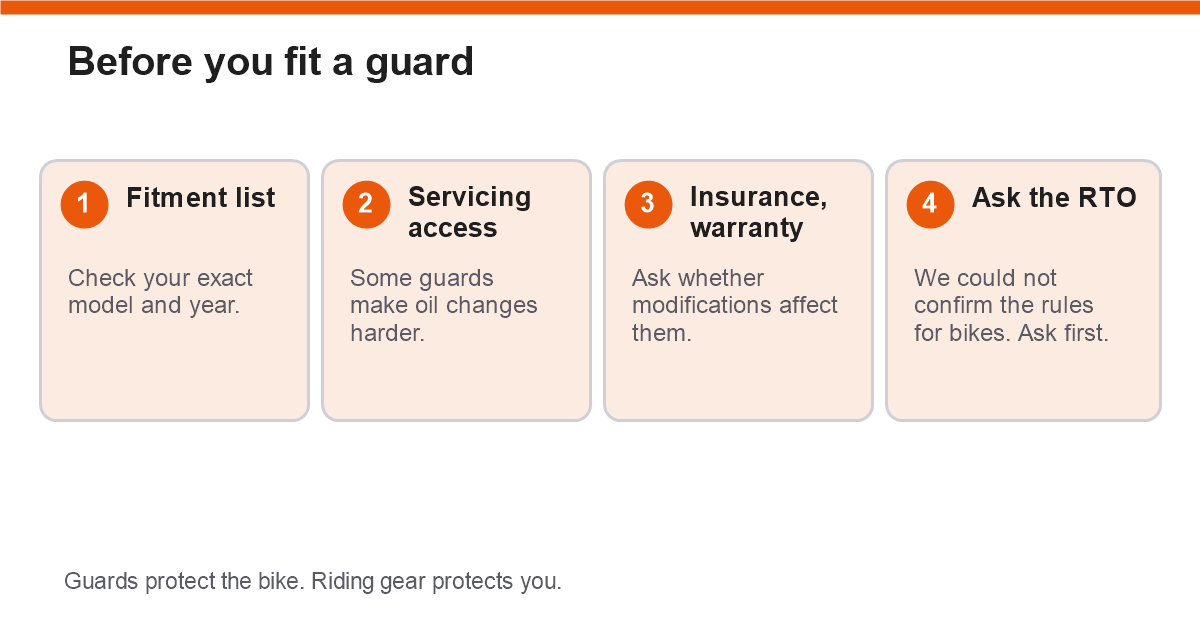
- Fitment list. Check the maker’s list for your exact model and year. A guard not made for your bike may not mount correctly.
- Mounting points. Check which bolts it uses. Some designs need parts of the bodywork to be cut, and you may not want that.
- Access for maintenance. Some guards make an oil change or chain adjustment harder. Check before you buy.
- Clearance. Make sure the guard does not touch the exhaust, cables, hoses or wiring, or reduce ground clearance or lean angle more than you accept.
- Weight and balance. Guards add weight. A heavy guard on a light bike changes how it feels.
- Quality. Check welds, finish and the mounting hardware. Use the hardware that comes with it, and tighten to the maker’s values.
What guards do not do
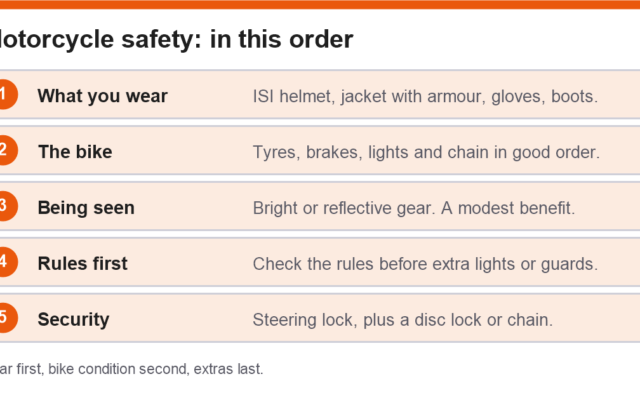
- They do not protect the rider. Riding gear does. See our jacket guide and safety accessories guide.
- They do not protect the bike in every fall. In a hard impact a bar can transmit force to the frame, so check your bike’s repair costs and the maker’s advice.
- Sliders can leave the bike dropping onto its panels if they dig in, according to some guides.
The rules in India
This is the part to check carefully. A Ministry of Road Transport and Highways letter dated 7 December 2017 asked states to act against unauthorised crash guards and bull bars on motor vehicles. News reports about it mostly discuss cars. We could not open the full letter or confirm how it applies to motorcycles. Section 52 of the Motor Vehicles Act, 1988 restricts altering a registered vehicle so its registered details no longer match, except with approval. We could not confirm whether a bolt-on crash guard counts as an alteration.
- Ask your local RTO or your dealer before fitting a fixed guard, and ask whether the maker offers an approved accessory for your model.
- Keep the receipt and the maker’s fitment details.
- Check your insurance and warranty terms, since some may be affected by modifications.
- Choose guards that do not stick out and do not carry extra lights or fittings that could be treated as other modifications.
Mistakes to avoid
- Buying a guard that is not made for your model.
- Choosing a style that makes routine maintenance difficult.
- Assuming a guard protects you as a rider.
- Fitting without checking local rules, warranty and insurance.
- Over-tightening or using the wrong bolts.
Who may not need one
If you ride a lightweight bike with cheap panels, or you rarely park on rough ground, the cost may not be worth it. Sliders can also be a poor choice off-road.
A quick checklist before you buy
- Decide what you want to protect: the bike in tip-overs, in slides or from the underside.
- Check the maker’s fitment list for your model and year.
- Check access for maintenance and clearance.
- Check the rules, your insurance and your warranty.
- Choose quality hardware and a finish that lasts.
Frequently asked questions
Are crash guards legal in India?
We could not confirm. A 2017 ministry letter concerns unauthorised crash guards and bull bars, mainly reported for cars. Ask your RTO or dealer about your bike.
Are sliders better than crash bars?
They suit different bikes and falls. Sliders suit sports bikes and slides, and crash bars suit tip-overs and rough ground.
Will a guard affect my warranty?
It can, depending on the maker’s terms. Ask your dealer before fitting.
Can I fit one myself?
Many fit with simple tools, but follow the instructions and tighten as advised. If unsure, ask a workshop.
Conclusion
Choose the type that matches your bike and how you ride, check fitment and access, and check the rules before you bolt anything to the frame. When we add specific recommendations, they will be clearly labelled.
Related guides
- Essential motorcycle safety accessories
- Saddle bags vs tail bags
- Browse more in Motorcycle Protection.
Sources
- Retailer and rider guides on crash bars, sliders and skid plates, for example Jalopnik and SW-Motech. They are media and sellers, so check the maker’s fitment list for your bike.
- Ministry of Road Transport and Highways: letter on unauthorised fitment of crash guards and bull bars, 7 December 2017 (we could not open the full text).
- Motor Vehicles Act, 1988, Section 52: as reproduced by Courtbook. Check the official text on India Code.